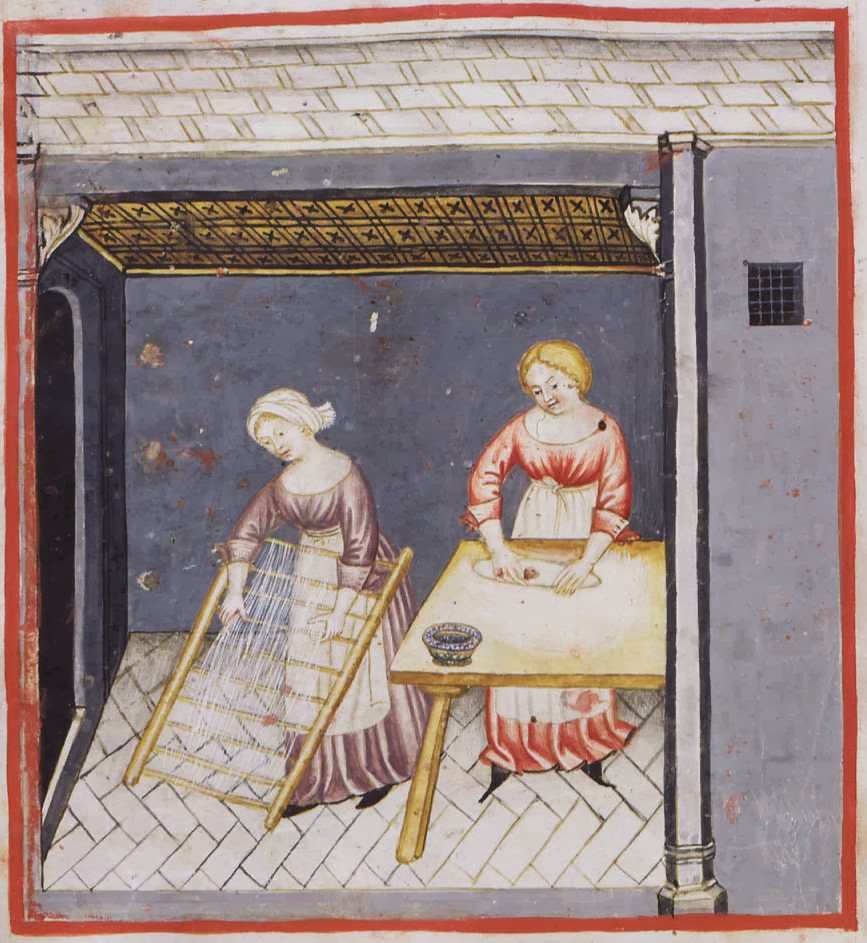
lunedì 23 dicembre 2013

Calze / Hoses

Appena in tempo per Natale ho finito le mie calze! Potrei provare ad appenderle vicino all'albero e vedere se Babbo Natale mi lascia qualche dono... in realtà di regali me ne sono già fatti a sufficienza: li "scarteremo" insieme quando il mio pacco arriverà.
Les Très Riches Heures du duc
de Berry, Febbraio
Ma torniamo alle mie calze. Dal punto di vista iconografico, ho purtroppo ben poco da dire: non ho mai visto documentazione inequivocabile di area italiana, complice la rarità di raffigurazioni di donne che mostrino le gambe o anche solo i piedi. Un debole indizio della presenza delle calze è, qua e là, un colore brillante che si intravede spuntare dalle calzature.
Una nota interessante proviene da Rosalie's Medieval Woman
Hose, as well as socks, were worn by medieval women. Our model woman Margherita Datini's wardrobe account of 1339 lists both white linen undersocks and long hose of silk or wool. The wife of a wealthy Italian merchant, Margherita had access to commercially produced items in the town, and would have worn what regular women of her class wore. 
Ovviamente sarebbe interessante individuare il documento per un confronto (e verificare la data citata, dal momento che Margherita nasce nel 1360 e muore nel 1423...) e vedere anche quali sono i termini originari tradotti con "undersocks" e "hose".
Tanto per darvi un'idea del modello che avevo in mente cucendo le mie calze, ecco un'immagine dal celeberrimo Les Très Riches Heures du duc de Berry, Francia, 1412 circa: due donne e un uomo si stanno scaldando davanti al fuoco, quella verso il fondo mostra chiaramente delle calze che sembrano arrivare fino al ginocchio, tenute forse ferme da una striscia di tessuto dello stesso colore (mostra anche qualcos'altro, ma non facciamoci caso...!). Anche la donna in primo piano ha probabilmente delle calze marrone chiaro.
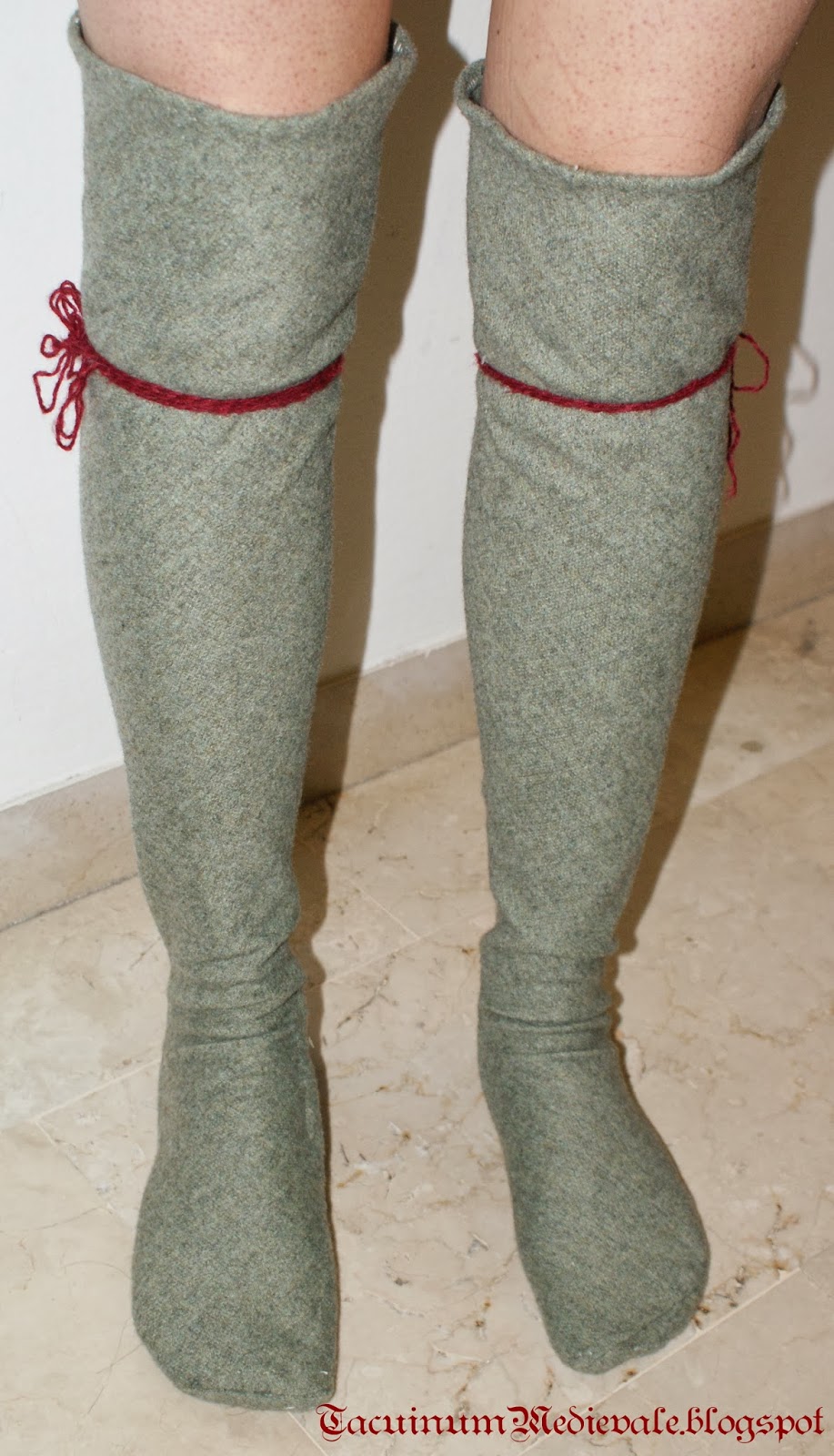

Calze terminate, mancano le giarrettiere!
Finished hoses, garters yet to come!
Il modello che ho utilizzato per le mie calze proviene dal Medieval Tailor's Assistant (pag. 104 sgg., fig. 7a): ho scelto il modello privo di cuciture sotto la pianta del piede, fidandomi, senza fare prima una ricerca, e, quando ormai le calze erano cucite, mi sono resa conto che non avevo ancora trovato un solo reperto della forma da me scelta. Per il momento mi assolvo dai miei peccati e tengo queste, quando farò le prossime sceglierò un modello documentato. L'aspetto che ritengo davvero fondamentale, tanto per le calze che per le calzabraghe da uomo, è l'aderenza, il fitting. Per ottenerlo, è importante partire da un modello personalizzato: io ho usato della stoffa di scarto e mi sono fatta aiutare a modellarla il più possibile. Riportando poi il modello sul tessuto finale,ho tagliato in diagonale il tessuto, per avere maggiore elasticità (dagli schemi del Medieval Tailor's Assistant dovrebbe risultare abbastanza chiaro il procedimento.)
Ho scelto della spessa lana grigia, per le mie calze, e ho cucito tutto a mano utilizzando del filo di lino bianco incerato. Ho usato il punto indietro per le cuciture principali, ho ribattuto tutte le cuciture usando il sottopunto (un lavoro lungo e noioso, ma utile per non avere la pressione della stoffa non ben distesa e anche per irrobustire le cuciture, evitando che la lana si sfilacci) e ho utilizzato, per i piccoli gheroni laterali, la tecnica testimoniata dai reperti della Groenlandia, cucendo cioè dal lato dritto del capo, non a rovescio. La tecnica, che a Battle of Visby abbiamo chiamato "The Perfect Gore", permette di centrare bene il gherone e di evitare i difetti che si possono verificare cucendo a rovescio. (Trovate su La Cotte Simple la spiegazione, utile per i gheroni di ogni capo d'abbigliamento)
Work in progress!
***
I finished my hoses just in time for Christmas! I should hang them near the Christmas Tree and see if Santa will leave any present for me... Actually, I've bought myself enough presents, we'll open them together when my parcel arrives.
But let's go back to my hoses - or stockings. I don't have much to say about artistic sources, because I've never seen any depiction in italian art, also because of the lack of images of women showing their legs or even their feet. A weak clue is, here and there, something coloured which can be seen inside the shoes. An interesting note comes from Rosalie's Medieval Woman
Hose, as well as socks, were worn by medieval women. Our model woman Margherita Datini's wardrobe account of 1339 lists both white linen undersocks and long hose of silk or wool. The wife of a wealthy Italian merchant, Margherita had access to commercially produced items in the town, and would have worn what regular women of her class wore. 
Obviously it would be interesting to find the document to ger more informations (ad verify the reported year, since Margherita was born in 1360 and dies in 1423...) and see also which are the original italian terms translated as "undersocks" and "hose".
Just to give you a clue of the model I had in mind while sewing my hoses, you can see a miniature from the famous Les Très Riches Heures du duc de Berry, France, about 1412: two women and a men are warming in front of the fireplace, the one at the bottom with the blue dress shows hoses reaching her knees, kept in place probably by a strap made of the same fabric (she is also showing something else, but let's not pay too much attention to it...!). The woman at the front may also be wearing light brown hoses.
L'interno del gherone. / The inside of the gore.
The model I chose for my hoses comes from the Medieval Tailor's Assistant (p. 104 and following, fig. 7a): I chose the one without seams under the foot and I admit I made no research before, so I realized only when the hoses where done that I hadn't seen any find having the shape I had chosen. For now, I absolve myself from my sins and I will keep them for a while in order to see how they're working and I will choose a proper shape for the next ones I'll make.
I think the fitting is truly important both for women's or men's hoses: to gain it, it's important to start from a personal pattern. I used scrap fabric and asked for help to make it as tight as possible. Cutting the wool, I decided to make a diagonal cut to have more elasticity (from the Medieval Tailor's Assistant schemes the process results quite clear).
Il piede il gherone visto da fuori. /
The foot and the gore.

I chose thick grey wool for the stockings and I hand-sew them using white waxed linen thread. I used backstitch for the main seams, I flattened all the seams using hem-stitch (a long and boring work, but useful to avoid messed fabric around the foot, to strenghten the garment and to prevent wool from raveling) and I used for the small "side-gores" a technique well documented by the Greenland clothes, i.e. I sew the gores from the right side, not from the wrong one. This technique, which we called "the Perfect Gore" at Battle of Visby, allows to place easily the gore in place and helps to avoid the flaws due to the wrong-side seams. On 
 
La Cotte Simple you can find useful instructions for every kind of garment.

mercoledì 11 dicembre 2013

2. Cuffia di S. Brigida: esempi italiani del XIV secolo / St. Brigit cap: italian examples in 14th century

Come anticipato, vi porto alcuni esempi di cuffie di S. Brigida rappresentate in materiale iconografico italiano del XIV secolo. La mia ricerca non si può certo definire esaustiva, ma credo possa già fornire qualche informazione utile sulla nostra cuffia. Non è sempre stato facile identificarla, e almeno un paio degli esempi che ho comunque deciso di pubblicare possono risultare un po' dubbi. I due elementi che ho considerato probanti per riconoscerla sono:
a) innanzitutto il loop, cioè il laccio che circonda la testa e sorregge in pratica questo modello di cuffia;
b) secondariamente, la forma "a sacco" sulla nuca, dovuta alla presenza dei capelli tenuti sciolti. Questa conformazione si vede in molte delle raffigurazioni più sicure della cuffia e in alcuni casi mi è sembrato un elemento sufficiente per l'identificazione.

As I promised, here I collected some examples of S. Brigit's cap as represented in the XIV century Italian sources. My research is far from being complete, but I think it may give some useful information about the cap. It's not always easy to identify it, and a couple of the examples I decided to publish may be not so certain. To identify it, I searched for 2 elements:
a) the loop that goes around the head and keeps this model of cap in place;
b) the "bagginess" of the back part of the coif over the neck, due to the hair that are kept usually free. This shape is very common in many clear depictions of the S. Brigit cap, so I sometimes considered it a satisfactory element to identify it.


Dalle immagini emerge quindi che la cuffia di S. Brigida è raffigurata indosso a donne impegnate in lavori all'aria aperta (soprattutto nei casi dei Tacuina Sanitatis) o in un ambiente domestico. Probabilmente quindi la sua praticità la rende un capo adatto a svolgere le faccende, insieme agli "asciugatoi" e ad altri semplici panni per il capo, dai quali non è sempre facile distinguerla. Inoltre, ho notato che si trova con grande frequenza nella rappresentazione delle ancelle o levatrici che lavano il bambino nelle varie scene della natività (della Vergine, del Battista o di Cristo): sono stata fortunata a trovare una vasta raccolta di immagini di natività su La Nativité italienne

Analysing the images, it's clear that the coif is worn by women working both in the open air (expecially in the Tacuina Sanitatis) or at home.  The cap it's so practice it can be easly worn when working, together with the "asciugatoi" (towels) and other easy headgears. Moreover, I found out it's very common in the representations on the Nativity (of the Virgin, of John the Baptist or of Christ), worn by the handmaidens or midwives who whash the baby: I was lucky to find a huge collection of nativities in the website La Nativité italienne

Qui sotto trovate la galleria, cliccate sui link sotto le immagini per vedere l'opera completa o ulteriori particolari. Come dicevo, questi sono solo alcuni esempi: mi farebbe piacere sapere se vi sembrano convincenti ed eventualmente ampliare la galleria delle attestazioni, nel caso aveste segnalazioni da aggiungere! 

Below you'll see the gallery, click on the links below the images to see the full paining or further details. As I said, these are just a few examples: I will be happy to hear if they seem convincing to you and I'd love to see more depictions in Italian art ad to add them to the gallery, if you have any.


1300, Memmo di Filippuccio, Palazzo del Podestà,
 S. Gimignano: scene di vita privata
Palazzo del Podestà: è raffigurata un'inserviente che prepara il bagno poi il letto per i coniugi. Ingrandendo l'immagine, si vede il laccio sulla parte posteriore della testa. Qui e qui le immagini complete. / 
Palazzo del Podestà: the housemaiden is preparing the bath and then the bed for a couple. Magnifing the picture, it's possible to see the loop. Here e here the complete image.
1303-1305, Giotto, Cappella degli Scrovegni, Padova
Annunciazione ad Anna.
Osservando i copricapi delle inservienti in un'altra scena, la nascita della Vergine, si nota la particolare cuffia della fanciulla di destra. /
 Observing the headgear of the maidens in another scene,  the Nativity of the Virgin, it can be seen the peculiar coif of the maiden on the right.

1323, Miniatore biadaiolo, Natività, Metropolitan Museum of Art,
New York.


1328, Simone Martini, il Beato Agostino salva bambino caduto dalla culla,
Siena (Polittico di S. Agostino da Novello)
Questo interessante esempio mostra come fosse possibile indossare un velo sopra la cuffia, che è ovviamente un supporto molto comodo su cui fissarlo per mezzo di spilli. La donna raffigurata è la balia. / This interesting example shows how the veil was worn over the coif, comfortably fixed with pins. This woman is a maiden who's taking care of the child.


Metà XIV sec., Maestro di Offida , Madonna con Bambino in trono e angeli, Chiesa di S. Maria Maggiore, Tursi
L'immagine è molto piccola, ma la donna che indossa la cuffia è nella seconda scena della colonna di sinistra, la "Natività di Giovanni": è una levatrice e indossa un abito verde e giallo. / The picture is very small, but the woman whos' wearing the cap is in the second scene in the left column, the "Nativity of John": she's a midwife and she's wearing a green and yellow dress.
1350- 1375, Bartolo di Fredi, San Nicola di Bari con le tre fanciulle, part.,
San Lucchese.
In questa immagine si può vedere che il loop in questo caso non è costituito da un unico pezzo ma sono due parti chiuse con un fiocco. / In this picture we can see that the loop it's not a one-piece strap but it's made with two strings closed with a knot. 


1395, Spinello Aretino, Natività, particolare
Courtault Institute of Art


 c. 1370-1400 Tacuinum Sanitatis (ONB Codex Vindobonensis, series nova 2644)
 fol. 104v, abbigliamento di lino
 c. 1370-1400
Tacuinum Sanitatis (ÖNB Codex Codex Vindobonensis, series nova 2644)
Raccolta dell'Issopo


Fine XIV sec, Ms.4182, Theatrum Sanitatis Biblioteca Casanatense
tav.47, spinaci; tav. 94, fagioli; tav. 120, pane; tav. 169, acqua. 

Anche qui si può vedere come il loop sia fissata con un fiocco. / Here we can see a knot instead of a loop too.


Nouvelle acquisition latine 1673, Tacuinum Sanitatis di Parigi
fol. 11, Raccolta delle castagne; fol. 58, Mercante di burro; fol. 96, acqua; fol. 97, donna che fa il bagno
.


giovedì 28 novembre 2013

1. La Cuffia di S: Brigida: alcuni link

Questo è il primo di una serie di post che ho intenzione di dedicare alla cuffia di S. Brigida: si tratta di un copricapo molto noto ai rievocatori nord-europei ma non molto presente nella rievocazione italiana. A Battle of Wisby ho partecipato a un workshop in cui abbiamo studiato la struttura del reperto e abbiamo iniziato insieme a realizzarne una nostra versione. Mentre concludevo la mia, ho cercato di capire se fosse attestata anche in Italia per il mio periodo di interesse... I risultati della mia pur breve ricerca saranno nel prossimo post, che sarà una raccolta di immagini che serviranno a inquadrare meglio l'uso della cuffia e che ne documentano la presenza anche in Italia nel XIV secolo.

La cuffia di S. Brigida è un tipo di copricapo femminile diffuso nelle fonti iconografiche europee dei secoli XIII- XV e testimoniato anche da un importante reperto, che si dice sia appartenuto a S. Brigida di Svezia. Generalmente, è composta da due pezzi di lino uniti al centro della testa da cuciture o ricami. L'elemento che la caratterizza è un loop che serve a renderla stabile quando indossata.


Morgan Bible/ Bibbia Maciejowski,
MS M.638 (fol. 19v), 1240 circa, Francia
consultabile online
Un primo ostacolo con il quale può accadere di scontrarsi avviando le ricerche su questo argomento sono le varianti linguistiche del nome della santa e del reperto: generalmente la forma "St. Birgitta" permette di individuare i risultati più importanti, ma segnalo anche:
- ingl.: Saint Brigid / Brigit’s cap / coif
- sved. : Birgittahätta / Birgittas huva
- danese: Birgitta- huen

- tedesco: St. Birgitta-Haube


Gli articoli on-line sull’argomento, che presentano diverse proposte ricostruttive o tutorial, sono molto numerosi e ho deciso di segnalare quelli che ritengo i più utili.
Larsdatter: sempre utile, link ad articoli e documentazione iconografica
* Medieval Silkwork: una delle autrici di questo blog è Isis Sturtewagen, autrice anche dell'importante articolo sul reperto (Dahl, C.L. & I. Sturtewagen, 2008, The Cap of St. Birgitta, Medieval Clothing and Textiles vol. IV, pp. 99-129) e di un post riassuntivo sulla cuffia di S. Brigida.
* Arachne's Blog: un primo esempio di ricostruzione e un secondo tentativo qui
* Middelaldercentret: esempio di ricostruzione, questo è un ottimo schema.
* Articolo in svedese di Åsa Martinsson con traduzione proveniente da questo blog.

mercoledì 20 novembre 2013

Un semplice grembiule / A simple apron

Il primo progetto che posso spuntare dalla lista delle cose da fare per il prossimo anno di rievocazioni è il grembiule. Si tratta naturalmente di un capo molto semplice e comune, ma ad una pur sommaria analisi iconografica ho potuto rilevare che tuttavia presenta alcune varianti. / The first project I can check on my to-do list is an apron. It's a simple and common garment, but I compared a few miniatures and I found out that there are some variations. 

* Telo annodato / Knotted canvas [fig. 1,2]
* Grembiule con allacciatura posteriore / Apron with back lacing [fig. 3]

1. Nouvelle acquisition
 latine 1673, fol. 35
2. Nouvelle acquisition 
latine 1673, fol. 63
3.Nouvelle acquisition
 latine 1673, fol. 61v


4.Nouvelle acquisition
 latine 1673, fol. 56
* Grembiule con allacciatura posteriore, (forse indossato sopra a un grembiule più ampio che copre dalle spalle ai piedi? Il colore delle maniche che si vedono è diverso dalla parte frontale del vestito). / Apron with front lacing (maybe wore over a wider apron that covers the body from the shoulders to the ankles? The sleeves are red while the rest of the garment is white) [fig. 4]


*Il modello che ho scelto io è quello più largamente  attestato nel Theatrum Sanitatis della Biblioteca Casanatense (Mss. Casanatense 4182), miniato in area lombarda e visibile per intero online qui [fig. 5,6]. Analizzando le diverse attestazioni, ho rilevato che il grembiule può essere allacciato sotto il seno o all’altezza dei fianchi e arriva a circa 15 cm da terra. Una peculiarità delle immagini di questo Tacuinum, che ho deciso di riprodurre, è che la cordella con la quale si allaccia il grembiule è spesso annodata sul davanti con un piccolo fiocco. Il tessuto che ho utilizzato è della vecchia canapa ed è stato cucito interamente a mano con del filo di lino. È largo circa 50 cm e lungo 90 (ma,confrontando il lavoro finito con le miniature, l'avrei potuto fare un po' più largo e un po' più corto).


6. Tav. 102 Mss. 1482, "Autunno"
5. Tav. 84 Mss. 1482

The model I chose is very common in the Theatrum Sanitatis of the Biblioteca Casanatense (Mss. Casanatense 4182), illuminated in Northern Italy (Lombardia), available here [fig. 5,6]. It can be laced under the breast or over the hips and it's 15 cm from the ground. A special feature of the aprons of this Tacuinum is that they are laced in the front with a small ribbon and I decided to reproduce it. I chose to use old hemp, the apron is completely hand-sewn with linen thread. It's 50 cm wide and 90 cm long (but, comparing the finished work with the miniatures, I could have made it a little bit larger and shorter).

Ecco finalmente il grembiule. Scusate per la bruttisima location!
Here's the apron. Sorry for the bad location!
Visione laterale del grembiule per confrontarlo meglio con l'iconografia.
Side view.

lunedì 23 settembre 2013

Non solo cucito: lavori di falegnameria

Le cerniere, forgiate a mano
Hand-forged hinges
I miei ultimi post iniziano sempre parlando di Wisby, e questo non fa eccezione: mentre io seguivo i workshop di ricamo e cucito, Francesco ha seguito un workshop sulla lavorazione del legno, in cui ha imparato come fare uno sgabello partendo da un tronco e lavorando solo con strumenti medievali. Non conta tanto il risultato, comunque soddisfacente, quanto il germe che è stato piantato, e sta dando i suoi primi frutti. Infatti Francesco ha già completato i primi due progetti, due bauli: quelli che abbiamo nella tenda sono stati fatti sempre da lui con l'utilizzo di strumenti moderni, mentre per questi sono stati utilizzati il più possibile strumenti antichi. Sono entrambi di legno di castagno, assemblati con chiodi di ferro e trattati con olio di lino, che fa un effetto davvero bello, oltre che un buon profumo.
La sperimentazione però non riguarda solo il legno, ma anche la lavorazione del metallo: anche le cerniere del baule più grande sono state infatti realizzate da lui, usando la forgia - ed era il primo tentativo di costruzione di un pezzo del genere!

Non mi resta che aggiungere che sono davvero orgogliosa dei sui lavori.
(E mi piace soprattutto il bauletto più piccolo, che è per me!)


Il bauletto più grande: 55x13x30 cm
The bigger chest: 55x13x30 cm

My last posts always start talking about Wisby, and this one is no exception: while I was attending embroidery and sewing workshop, Francesco was following a workshop about woodworking, where he learnt how to make a stool starting from the tree trunk and using only period tools. The stool looks great, but the most important thing is that a seed has been planted, and it startet giving the first results. Francesco actually completed the first two projects, two chests: he made also the ones we have in our tent right now, but he used modern tools, while for these ones he used as much as he could period tools. Both are made wish chestnut wood, assembled with iron nails and treated with linen-seed oil, wich looks great and smells good.
But this isn't only about wood experiments: he made also the hinges for the bigger chest, using a forge - and this was the first time he tryed to make this kind of piece.
I am so proud of his works!
(And I expecially love the little 

one- 
which is for me!)
My little one: 23x16x13 cm


martedì 17 settembre 2013

Pins&Love: molti spilli, molto amore

Finalmente è giunto il momento di prendersi un momento di pausa dalle rievocazioni... come ogni anno, in questa stagione arriva il momento di riprendere il controllo della mia vita e dedicarmi nuovamente ai miei impegni più normali (come l'università...) pur mantenendo degli spiragli di Medioevo nelle mie giornate, quanto basta per non sentirne troppo la mancanza.


Nell'ultimo week end di rievocazione ho colto l'occasione per fare due portaspilli, uno per incoraggiare un amico che sta imparando a cucire, un altro per me, dove tenere al sicuro sia gli spilli "normali" che uso per il cucito sia quelli storici che uso per il velo: sono tutti acquisti recenti, infatti i due più piccoli con la capocchia a diamantino, copie in lega di rame dei reperti di Londra, li ho comprati dal Merchatante Ladro, mentre i due placcati in argento e i quattro di bronzo con il filo arrotolato, anch'essi basati su degli originali, sono realizzati da Annie e vengono direttamente da Wisby. Sono felice di avere finalmente un po' di assortimento di spilli, e sono veramente soddisfatta di quelli argentati, sono così sottili e lisci che posso usarli con il velo di seta senza rovinarlo troppo.

L'ispirazione per il portaspilli è arrivata dalla Svezia, infatti tra le rievocatrici ne ho visti diversi fatti in questo modo: è stato ricavato da un ritaglio di lana spessa all'interno della quale è stato cucito del lino azzurro, i cordini sono di lana, fatti con 2 fili.


At last, it's time to take a break from re-enacting... like every year, in this season it's time to take back my life and start to work again to my normal activities (like university...), but I still keep some medieval moments in my days, just not to miss it too much.


During the last event, I made two little pin-cases, one to encourage a friend of mine who is learning how to sew and anothe one to keep my beloved pins safe, bot the "normal", modern ones I use for sewing and the period ones I use to fasten my veil. I bought all of them this year: the diamond-head ones (in copper alloy) are from the Merchatante Ladro, while the two silver-plated ones and the four with a twisted edge (in bronze) are by Annie and come directly from Wisby. I'm really happy with the silver pins, they are so thin and smooth I can wear them with my silk veil without ruining it too much.


The ispiration for the pin-case came from Sweden as well, because I saw many of them amongs the re-enactors. 
This pin-case is made with thick wool and light blue linen, the cords are in wool, with 2 strings. 

martedì 27 agosto 2013

Battle of Wisby 1361: The tale of a dream come true


Sono passati molti mesi dall'ultimo post, ma l'estate è stata piena di attività artigianali per il materiale da rievocazione e, soprattutto, ha visto realizzarsi il sogno di tornare a Visby da rievocatrice. Nel momento stesso in cui ho lasciato quella terra nel 2009, dopo aver partecipato per 4 giorni alla Medieval Week, ho saputo che sarei tornata. Per una incredibile congiunzione di circostanze favorevoli (e molto lavoro), quel sogno, quest'anno, è diventato realtà, e ha superato ogni aspettativa (che, come mi conosce ben sa, era alta.) Partecipare per una intera settimana a Battle of Wisby è stata un'esperienza di straordinaria intensità: vivere insieme ad altri 200 rievocatori in accampamento per così tanto tempo ha reso possibili amicizie che un solo week end di solito non permette di costruire. Non basterebbero infinite parole a descrivere Battle of Wisby, ma se ne dovessi scegliere solo una, sceglierei "condivisione": di sapori, di idee, di cibo, di materiali, di vini, di esperienze, ma soprattutto di conoscenze, che rappresentano il dono più grande.

Dopo Wisby, niente sarà mai più lo stesso, per me.
Nonostante siamo arrivati praticamente alla fine della stagione rievocativa, ho ancora dei progetti da completare, come ad esempio quelle 120 asole da finire entro venerdì pomeriggio che mi guardano in cagnesco per essermi presa questa pausa...


Io e i miei compagni d'avventura, Andrea e Francesco.
Me and my fellows in this adventure, Andrea and Francesco.


This is my first post both in Italian and English: I apologize if my English will not always be very good, I'll do my best!


Many months have passed since I last posted something, but summer has been full of activity to make the material for the events and, most of all, my dream to come back to Visby as a re-enactor became true. In the exact moment when I left this beautiful land in 2009, after spending 4 days at the Medieval Week, I knew I would have come back. Thanks to incredibly lucky circimstances (and a lot of work), that dream, this year, came true, and definetly overcame my expectations (which were very high...) Staying a whole week in Battle of Wisby has been an incredibly intense experience: living together with 200 re-enactors for such a long time let us know each other in a way a week-end long event would have never made possibile. Words are not enough to tell what Battle of Wisby has been, but, if I only had to choose one, it would be "sharing": ideas, food, materials, wine, experience, but, most of all, knowledge, which is the biggest gift.
After Wisby, nothing will ever be the same to me.
Even though we are almost at the end of the season, I still have some projects to work on, like the 120 button holes that have to be finished before friday afternoon and are looking bad at me because of this little break from sewing...


Ne è valsa la pena di viaggiare per 2300 kilometri per vedere un posto così, aprendo gli occhi ogni mattina...
Its worth it to travel for 2300 kilometers just to see a place like this, waking up every morning...