Visualizzazione post con etichetta sewing. Mostra tutti i post

lunedì 18 settembre 2017

Il matrimonio di Damisella e Todeschino - Damisella and Todeschino's wedding 16.9.2017


Tutto  è iniziato con questa foto, nell’agosto del 2016. Eravamo a Visby, a guardare la tempesta avvicinarsi dal mare: io e Francesco avevamo chiesto a Mervi di farci una foto insieme: “Questa foto la manderete agli amici e ai parenti quando li inviterete al vostro matrimonio!” Dopo uno scambio di occhiate, abbiamo risposto che sì, poteva essere una buona idea, dal momento che avevamo deciso di sposarci a settembre 2017: così Mervi è stata la prima persona a ricevere la notizia.
La decisione era stata presa da tempo: il matrimonio sarebbe stato celebrato con rito civile, alla Rocca di Imola. Io e Francesco avremmo indossato abiti medievali veramente speciali, realizzati apposta per l’occasione. Eravamo sicuri che Mervi sarebbe stata la persona giusta a cui affidare il lavoro, la persona giusta ad affrontare questa avventura insieme a noi.


Everything begun with this picture, in August 2016. We were in Visby, looking at the storm approaching from the sea: me and Francesco had asked Mervi to take a picture of the two of us together. “This is the picture you will send to your friends and relatives when you invite them to your wedding!” Me and Francesco stared at each other, we said that yes, it could be a good idea, as we had decided to get married in September 2017: so Mervi was the very first person to hear the news.
The decision had been taken a long time before: the wedding was going to take place in the Rocca (Castle) of Imola, and me and Francesco were going to wear very special medieval clothes, made for the occasion. We were sure Mervi was the right person to take care of the work, the right person to join us in this adventure.

.:Potete leggere il post di Mervi dedicato alla realizzazione degli abiti, con foto, QUI:.
.: Check out Mervi's blogpost about the making of the dresses, with pictures, HERE:.

Le nostre miniature di riferimento (riunite grazie a Photoshop!)
Our sources (re-united thanks to Photoshop!)

Missale et horae ad usum fratrum
minorum, Lombardia, 1380,
BNF Latin 757 327v. 

La scelta dell’iconografia di riferimento
I personaggi cui idealmente ci rifacciamo e che abbiamo ipotizzato di ricostruire sono sempre i nostri Todeschino Alidosi, fratello di Bertrando (signore di Imola dal 1362 al 1391), e sua moglie Damisella Gonzaga, figlia di Luigi Gonzaga, primo capitano del popolo di Mantova. Il loro matrimonio si svolse nel febbraio 1367 - esattamente 650 anni fa.
Per realizzare un progetto organico e coerente, abbiamo scelto di attenerci il più possibile a una singola fonte iconografica, integrandola con altri elementi di tipo documentario o archeologico quando necessario. I due personaggi che abbiamo scelto provengono dal (mio amatissimo) Missale et horae ad usum fratrum minorum (BNF Latin 757):
- la principessa di San Giorgio e il drago
- il committente del libro d’ore inginocchiato ai piedi della Vergine
Entrambe le raffigurazioni ci sono sembrate adatte a rappresentare in maniera sostanzialmente realistica la moda dell’epoca, sia per lo stile complessivo delle miniature che per il ruolo dei personaggi.


Missale et horae ad usum fratrum
minorum, Lombardia, 1380, 
BNF Latin 757 109v. 
Choosing the source


The characters we ideally aim to represent are our dear Todeschino Alidosi, brother of Bertrando Alidosi (lord of Imola between 1362 and 1391), and his wife Damisella Gonzaga, daughter of Luigi Gonzaga, first captain of Mantova. Their wedding took place in February 1367 - exactly 650 years ago.
In order to start an organic and consistent proejct, we decided to build our work on a single iconographic source, integrated with written documents or archeological finds when needed. The two sources we chose come both from (my beloved) Missale et horae ad usum fratrum minorum (BNF Latin 757):
  • The princess from the scene of Saint George and the dragon
  • The client of the Book of hours, kneeling in front of the Virgin
Both these depictions seem to represent in a quite accurate way the fashion of the time, both for the overall style of the enluminures and the role of these characters.


La stoffa
Il pezzo forte dell’intero progetto è stata fin dall’inizio la stoffa da utilizzare per le sopravesti. Desideravamo da anni trovare qualcuno in grado di riprodurre un broccato trecentesco, che avesse non solo un pattern documentato, ma che fosse anche realizzato con i materiali più corretti possibili: questa scelta ci ha portato quindi a escludere tessuti realizzati in rayon e lurex.Dopo una lunga ricerca, abbiamo trovato un artigiano italiano in grado di tessere a mano dei damaschi di seta e filo d’oro (composto da un’anima di cotone, ricoperto da una sottile lamella d’argento placcata in oro). Dal momento che non ci è sembrata una procedura  abbastanza affidabile estrapolare il motivo decorativo della stoffa soltanto dall’iconografia -che pure a volte offre rappresentazioni di tessuti molto simili a reperti -, abbiamo deciso di conservare il colore della miniatura, ma di riprodurre il tessuto a partire da frammenti esistenti:
- Uccellino con il cardo e la luna, produzione italiana (Lucca), ora al museo della cattedrale di Uppsala
- Cervo con cane, colomba e cigno, produzione italiana, ora Metropolitan Museum
La maggiore differenza dei nostri tessuti rispetto agli originali è la tecnica con cui sono stati realizzati: a differenza dei broccati medievali, dove il pattern è visibile solo sul dritto e i fili metallici sono inseriti solo in corrispondenza dei disegni, i damaschi presentano una struttura a double-face, in cui il filo di ordito (in seta) e il filo di trama (in oro) sono sempre presenti su tutta la superficie. Allo stato attuale, i damaschi ci sono comunque sembrati la soluzione più valida e convincente, a livello visivo e nella scelta dei materiali, per tentare una ricostruzione dei broccati medievali.


The fabric
The centerpiece of the project was the fabric to be used for the overdresses. We have been wanting for years to find someone capable of reproducing a 14th century brocade, that not only had a documented pattern, but that was also made of the correct materials - therefore excluding textiles made out of rayon and lurex. After a long research, we found and Italian weaver who could hand-weave damask made of silk and golden thread (a cotton thread with a thin leaf of silver, gilded). As it didn’t seem trustworthy enough to reproduce the pattern of the fabric only from the pictorial evidence - even if sometimes the textiles depicted match the actual sources quite well -, we decided to keep the colour of the dresses in the enluminures, but we chose to reproduce extant 14th century brocades:
- Bird with the thistle and moon, Italian production (Lucca), now in Uppsala Cathedral
- Deer with dog, dove and swan: Italian production, now Metropolitan Museum of New York
The main difference between our fabric and the original brocades is the weaving technique: in medieval brocades the gilded thread is only inserted where the figures appear and the pattern is visible only from the right side, damask instead has a double-face structure, therefore the silk threads (warp) and the gilded thread (weft) are both present all over the surface. Damask seemed for us the most convincing solution right now to try to reproduce medieval brocades, both for visual effect and choice of materials.


Missale et horae ad usum fratrum
minorum, Lombardia, 1380, 
BNF Latin 757 322r.
Gli abiti di Todeschino
  • Braghe di lino
  • Calzabraghe in lana rossa (twill) leggera
  • Camicia
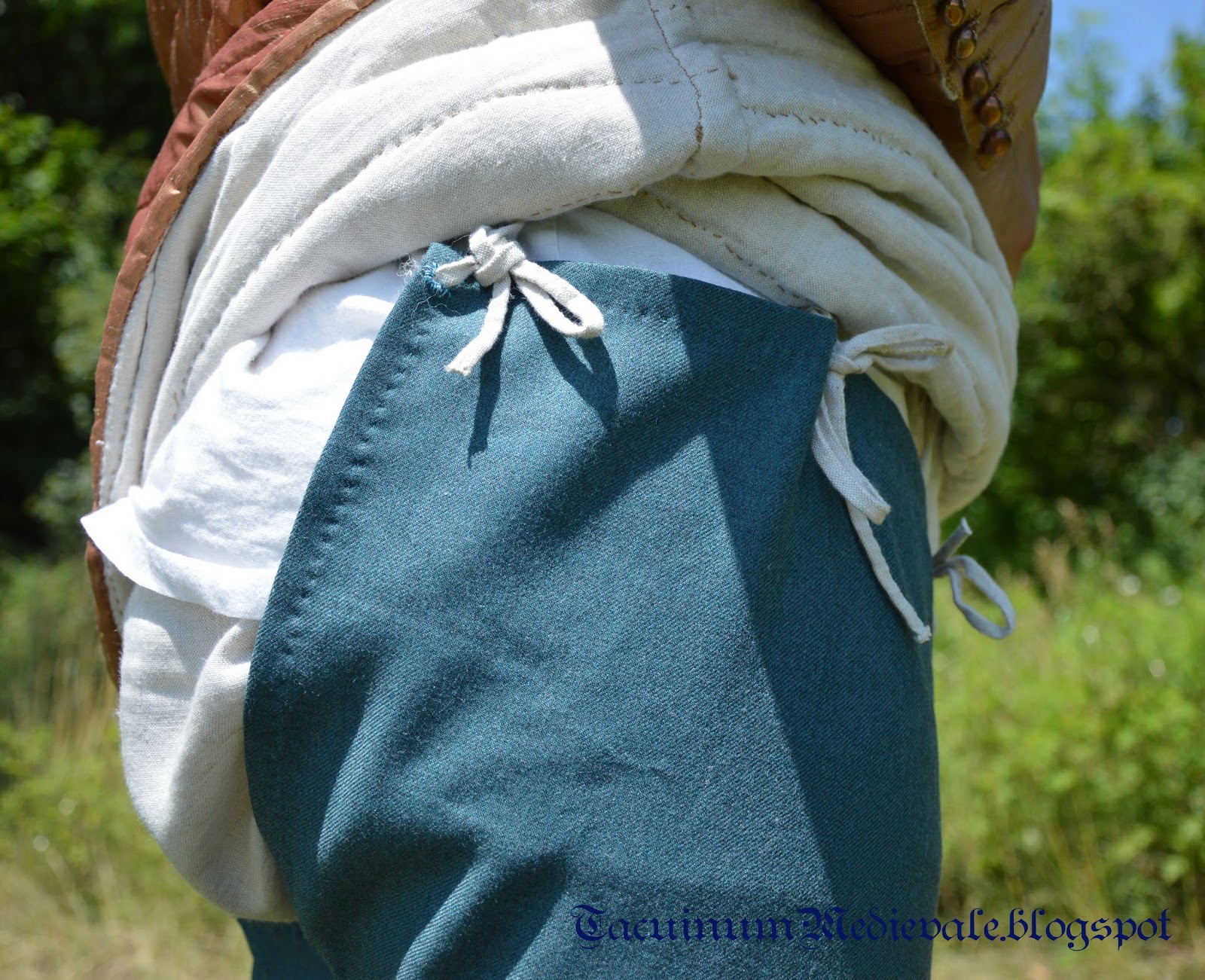
  • Farsetto:  abbiamo ritenuto l’elemento del farsetto imbottito fondamentale per conferire al corpo la tipica forma “a clessidra” (o “a levriero”, secondo i contemporanei), compatibilmente con la struttura fisica di Francesco. È al farsetto che sono fissate le calzabraghe, tramite dei cordini: questa soluzione, già sperimentata con il pourpoint, permette di fissare le calzabraghe molto in alto e di coprire in modo molto efficace la braga, che non è mai visibile soprattutto nel caso di persone di alto ceto sociale.
  • Gonnella in seta leggera, con bottoni metallici.
  • Sopraveste in damasco di seta e oro, con bottoni realizzati di stoffa (assenti nell’iconografia originaria, ma necessari per poter indossare il capo), foderata di taffeta di seta azzurra, con le maniche foderate parzialmente di pelliccia di coniglio.
  • Scarpe (realizzate da Graziano Dal Barco - Historical Italian Shoes): il committente indossa nella miniatura delle calze solate, ma non ce la siamo sentita di fare affidamento su questa soluzione il giorno del matrimonio, quindi abbiamo deciso di commissionare un paio di scarpe basate sulla coeva fonte del Giron Le Courtois (NAF 5243, 73v.) Le scarpe sono realizzate in cuoio marrone scuro e interamente cucite a mano
  • La cintura d’argento, montata su velluto di seta (realizzata da Giovanni Rotondi - Il gatto e la volpe), sarà oggetto di un post dedicato .


Todeschino’s garments
  • Linen braies
  • Hoses made of thin, red wool (twill)
  • Smock
  • Doublet: we think that the padded doublet is an extremely important piece of clothing to shape the body according to the fashionable “hourglass” shape. The hoses are fastened to the doublet with strings: this solution, we already tested with the pourpoint, allows to fasten the hoses in a very high position and to cover the braies more easily, as they are never visible, expecially on high-status charachters.
  • Kirtle in thin silk, with metal buttons
  • Overdress made of silk and golden damask, with fabric buttons (absent on original source, but necessary to wear the garment), lined with light blue silk taffeta, with sleeves partially lined in rabbit fur.
  • Shoes (made by Graziano Dal Barco - Historical Italian Shoes): the client in the enluminure is wearing soled hoses, but we didn’t dare to count on this solution on the wedding day. So, we decided to order a pair of shoes based on a source from the same period, Giron Le Courtois (NAF 5243, 73v.) Shoes are made of dark brown leather and completely hand-sewn.
  • The silver belt, mounted on silk velvet (made by Giovanni Rotondi - Il gatto e la volpe) will have a post on its own.


Gli abiti di Damisella
  • Camicia supportiva in lino, senza allacciature
  • Veste in taffeta di seta rosa, con allacciatura laterale a spirale. La particolarità di questo abito sono le maniche: nell’iconografia di riferimento, si vede chiaramente una decorazione a spirale realizzata probabilmente con delle perle. L’utilizzo di perle cucite sugli abiti viene - da un lato - spesso vietato nelle leggi suntuarie (Bologna 1398, ma viene anche documentato nei corredi più lussuosi (ad esempio l'inventario nuziale del 1391 di Rengarda Alidosi figlia di Bertrando, in cui compaiono perle ricamate su cappucci e cotte) . La realizzazione del ricamo, con perle di fiume di 3-4 mm di diametro, ha richiesto circa 15 ore di lavoro. La chiusura della manica si effettua tramite un sistema a gancetti e occhielli, molto popolare nel XV secolo, ma probabilmente già in uso nel secolo precedente, come si ricava da inventari di sarti e qualche reperto locale. Questa scelta è stata preferita ai più comuni bottoni perché avrebbero interferito con la continuità della decorazione e non sono inoltre visibili nella fonte.
  • Sopravveste di damasco di seta e oro, foderata di lana bianca con decorazione di perle di fiume e pietre (calcedoni e quarzi rosa) montate su castoni dorati. La sopraveste, allacciata lateralmente, è basata sulla gonna d’oro della regina Margherita di Svezia oggi conservata a Uppsala, l’unico reperto esistente di un abito di lusso femminile di epoca medievale.
  • Calze di lana
  • Scarpe (realizzate da Graziano Dal Barco - Historical Italian Shoes): l’ipotesi ricostruttiva è partita dalla piccola, elegante punta della scarpetta che appare sotto l’abito della principessa della miniatura. Per ricostruire il resto della scarpa, abbiamo scelto di adottare una decorazione traforata a fiori documentata in alcune immagini del Guiron Le Courtois (NAF 5243, 36r.), anche loro sono realizzate in cuoio e cucite a mano.
  • Anche la corona in rame dorato, pietre e perle sarà trattata in un altro post (realizzata da Giovanni Rotondi - Il gatto e la volpe).


Damisella’s garments
  • Supportive underwear in linen, without lacing
  • Dress in pink silk taffeta, with side spiral lacing. The special feature of this dress are the sleeves: in the picture, it’s clearly visible a spiral decoration, probably made of pearls. Pearls sewn to garments are - on one side - often prohibited by sumptuary laws (Bologna 1398), but it’s also mentioned in luxury inventories (for example, Rengarda Alidosi, Bertrando's daughter, wedding inventory from 1391, in which appear pearls embroidered on hoods and dresses). The embroidery is made with freshwater pearls with 3-4 mm in diameter and it took about 15 hours of work. The sleeve is fastened with hooks and eyes, very popular in 15th century, but probably already in use in 14th century, as can be found in some tailor shop inventories and local finds. Hooks and eyes have been chosen instead of buttons because buttons would have interfered with the continuity of the pearl decoration and are not visible on the source as well.
  • Overdress in silk and gold damask, lined with white wool, with a decoration on the neckline made of freshwater pearls and gems (pink quartz and chalcedony) on gilded bezels. The overdress, with side lacing, is based on Queen Margareta’s golden gown, today preserved in Uppsala’s cathedral, the only extant ceremonial female garment  from medieval times.
  • Woolen hoses
  • Shoes (made by Graziano Dal Barco - Historical Italian Shoes): the recreation of the shoes started from the small, elegant point of the shoe that appears from underneath the dress of the princess in the enluminure. The rest of the shoe is an openwork with flowers based on Guiron Le Courtois (NAF 5243, 36r.) these shoes are made of leather and hand-sewn.
  • Also the crown, made of gilded copper, gems and stones will be described in another post (made by Giovanni Rotondi - Il gatto e la volpe).


Non potremmo essere più riconoscenti nei confronti di tutte le persone che hanno contribuito alla realizzazione del nostro sogno, in particolare grazie Mervi Pasanen per aver accettato l’incarico non poco oneroso di tagliare, confezionare e cucire a mano tutti gli abiti, un’impresa non facile fin dall’inizio e complicata ulteriormente da qualche migliaio di chilometri di distanza!

We couldn’t be more thankful towards all the people who made possible our dream, expecially to Mervi Pasanen who accepted the not-so-easy task to cut, put together and hand-sew all our garments, an hard challenge from the beginning, made even harder by a few thousand kilometers between us!

[Le foto ufficiali saranno caricate non appena disponibili - Official pictures will be uploaded as soon as they're available]

sabato 12 settembre 2015

Seta e perle per Damisella / Silk and pearls for Damisella

Questo abito e i suoi accessori sono stati progettati e realizzati per ricostruire il personaggio storico di Damisella Gonzaga, ultima figlia di Luigi Gonzaga, primo capitano del popolo di Mantova: andò sposa a Alidosio Alidosi, detto il Todeschino, il 10 febbraio 1367, portando una cospicua dote, all’altezza della fama e della ricchezza della sua famiglia di origine.

This dress and its accessories have been planned and realized to re-enact the historical character of Damisella Gonzaga, last daughter of Luigi Gonzaga, captain of Mantua: she married Alidosio Alidosi, called the Todeschino, the 10th of February 1367, bringing a conspicuous dowry, up to the reputation and wealth of her family.


Di fronte al Castello San Giorgio di Mantova: "Damisella" è tornata a casa per un giorno.
In front of the Castle of Saint George in Mantova: "Damisella" is back home for a day. 
I materiali
La protagonista dell’abito è sicuramente la seta verde: si tratta di una seta dupioni, venduta come tessuta a mano,  che ho acquistato un paio di anni fa. Dal momento che la seta era troppo sottile e non cadeva bene, dopo molte indecisioni ho deciso di foderare il corpo e la gonna in lana, in modo che desse peso all’abito. Le maniche sono invece state foderate di lino, per non aggiungere troppo spessore e anche perché, indossandolo con la camisa supportiva senza maniche, non volevo avere la lana a diretto contatto con le braccia: la fodera in lino delle maniche sembra essere attestata anche nella “gonna d’oro” della regina Margareta di Danimarca, che presenta anche una fodera di lino sul busto, estesa anche per 40-50 centimeti della gonna.  Per rifinire la scollatura e darle maggiore robustezza ho usato una sottile striscia di taffetà: finiture analoghe sono testimoniate anche da alcuni frammenti di Londra (Textiles and Clothing 1150- 1450, 158s.). Tutte le cuciture sono fatte a mano: quelle esterne in  filo di seta, le cuciture della fodera di lino.
NOTA: la seta tessuta a dupioni probabilmente non è la scelta migliore: suggerirei invece di usare taffetà di seta. 


The materials
Allacciatura laterale a spirale. /
Side spiral lacing.
The protagonist of this dress is for sure the green silk: it’s a dupioni silk which was sold as “hand woven”, and I bought it a couple of years ago. Since the silk was too thin and didn’t fall in a proper way, I decided to line the bodice and gown in wool, in order to get more weight. The sleeves have been lined in linen, to avoid too much thickness and to avoid direct contact with wool on the arms, since I wear this dress with the sleeveless supportive underwear.  The linen lining in sleeves seems to be present also in the “golden gown” of Queen Margareta of Denmark, that is also lined in the bodice and in the gown for 40-50 cm.The neckline has a narrow silk facing in taffeta to strengthen it, according to some finds from London (Textiles and Clothing 1150- 1450, 158s.). All the dress is hand sewn: the external seams are in silk, the ones of the lining are in linen.
NOTE: dupioni silk is probably not the best choice. I would recommend to use silk taffeta instead. 


Nouvelle acquisition latine 1673, fol. 8:
raccolta dei fichi / harvesting figs.
Il modello
Il modello non è la riproduzione fedele di nessuno dei reperti esistenti: si basa in parte sulla “gonna d’oro”, in particolare per la divisione in quattro quarti del davanti e del dietro e per la scelta di non dare forma rettangolare ma trapezoidale a queste parti, richiamando la forma dell’originale, ma si differenzia per la presenza di 4 gheroni che partono dall’altezza dei fianchi, 2 frontali e 2 laterali, necessari per raggiungere l’ampiezza voluta (3.5 m). Le maniche sono ricavate da un’unico pezzo, senza l’inserimento di gheroni, e sul polso hanno la forma “a campanella”, comune per gli abiti ricchi del periodo: non possono mancare i bottoni, 15 per ogni manica. Alcuni dettagli sono stati scelti per renderlo il più coerente possibile con la moda italiana: 
- la scollatura abbastanza pronunciata e rotonda (avrei potuto osare di più e renderla più a barca, ma non volevo rinunciare ad avere il supporto sulle spalle, a causa del peso del vesitito: per una bella analisi sulle scollature, La Cotte Simple );
- l’allacciatura laterale, testimoniata da alcune fonti iconografiche. Per avere una buona chiusura dell’abito, suggerisco di utilizzare un’allacciatura a spirale, testimoniata nelle fonti (a differenza dell’allacciatura a “x”) e molto efficace. Qui “The Zen of Spiral Lacing”  e qui l’articolo di Tasha Kelly. Il cordino è lungo 3 metri, per non doverlo sfilare e infilare ogni volta, ed è tessuto con filo di seta per le asole, con 4 tavolette. Grazie a Mervi per le istruzioni!
Il toile su cui si basa il vestito è quello fatto durante il workshop di cucito.
L’abito è un “primo strato”, da indossare quindi sopra la biancheria intima, al quale spero di aggiungere il prossimo anno un secondo strato sufficientemente ricco.

Dettaglio del cordino dell'allacciatura. /
Detail of the string of the side lacing.
The model
The model is not the faithful replica of any existant garment: it’s partly based on the “golden gown”, expecially for the division in 4 parts of the front and back and for the choice to give a trapezoidal shape instead of a rectangular one to these parts, more like the original, but it’s different because of the 4 hip-heigh gores I needed to have a proper hem size (3.5 m). The sleeves are made in a single piece, without inserting any gore, and have the “bell shape” common in some rich garments of the period: of course there are buttons, 15 for each sleeve. Some details have been chosen to match the Italian fashion best:
- the deep, rounded neckline (I could have dared more and made it more boat-like, but I wanted to have support on the shoulders because of the weight of the dress. For a nice analysis of necklines ,La Cotte Simple ) 
- the side lacing, as shown in some Italian pictures. To have a good lacing, I really suggest to use the spiral lacing, which is portrayed in the sources (the “x” lacing is not) and very effective. Check out the “Zen of spiral lacing” and here a nice article by Tasha Kelly about lacing. The string, which is 3 meters long so I don't have to insert and take it away every time, is tablet woven with 4 tablets, and it's made in buttonholes silk. Thanks to Mervi for the instructions!
The toile I used is the one we made during the medieval sewing workshop I organized in February. 
This dress is a “first layer”, to be worn over the underwear, and I hope I will give it a proper second layer next year. 


1369, Oratorio di S. Stefano, Lentate sul Seveso. Le fanciulle,
figlie della famiglia Porro rappresentata nell'atto di donare
l'oratorio, hanno maniche a campanella e, guardando
attentamente, si vede che indossano anelli nell'indice e nell'
anulare. / 1369, Oratorio of S. Stefano, Lentate sul Seveso.
The young ladies are daughters of the Porro family, portrayed
when donating the oratory. They have bell-shaped sleeves and,
looking carefully, you can see they wear rings in index and
ring finger.


Gli accessori
Un abito non è abbastanza per creare un’immagine coerente di un personaggio, quindi ho cercato di aggiungere anche alcuni accessori per arricchire l’insieme. 
The accessories
A dress is not enough to create a coherent portrait of a character, so I looked for some accessories to improve the ensemble.

- Collana di perle e corallo
Missale et Horae ad usum
 Fratrum Minorum
(1385- 90, BNF Latin 757, 258v.) Fanciulla
con terzolla e collana. / A lady with
a "terzolla" and necklace.
Nelle fonti italiane, e molto meno in quelle straniere che mi è capitato di vedere, ricorrono collane di varie forme: sono le fonti documentarie però a venirci in aiuto informandoci sulle pietre preziose più usate. Io ho scelto corallo (madrepora) e perle, sia perché facilmente distinguibili anche nelle miniature, come quelle dei Tacuina Sanitatis, sia perché esplicitamente menzionati in un documento imolese del 1391, contenete la stima della dote di nozze di Rengarda Alidosi, figlia di Beltrando: «Item una collana di perle facta a poste con coragli in mezo in fili bianchi de seda che pesa onze 2 ½, estimat ducati 30». 
- Necklace in pearls and corals
In the Italian sources, and a lot less in foreign ones I stumbled upon, there are a lot of different necklaces: the written sources can tell us more about the most common gems in use. I decided to use coral (actually madrepore) and pearls, because they can be clearly seen in miniatures, like the ones from Tacuina Sanitatis, and also because they are mentioned in a document from Imola dated 1391, that includes the valuation of the dowry of Rengarda Alidosi, daughter of Beltrando: “A necklace of pearls, made for this occasion, with corals in the middle, on white silk threads: it weights 2 ½ ounces, it worths 30 ducats”. 

- Anelli
Spesso menzionati negli inventari e nelle leggi suntuarie, dovevano essere un accessorio particolarmente apprezzato e diffuso. I due di cui dispongo al momento sono realizzati da Il Gatto e la Volpe sulla base di originali romagnoli: uno è in bronzo e granato, l’altro in argento e smeraldo. 
- Rings
Often mentioned in inventories and sumptuary laws, rings must have been very common and appreciated. The two I have now are made by Il Gatto e la Volpe, after some originals from Romagna: one is in bronze and garnet, the other one in silver and emerald.


- La terzolla: un’ipotesi e un tentativo
La vera impresa di questo outfit è stata l’acconciatura. Da tempo desideravo cercare di ricostruire la misteriosa “terzolla”, copricapo che la Muzzarelli (Guardaroba Medievale, p. 361) definisce «acconciatura a ornamento del capo, così detta perchè fatta con 300 perle» e probabilmente a volte chiamata semplicemente dalle fonti “ghirlanda” o “ghirlanda con perle”. Non ho mai trovato il nome “terzolla” associato da autorevoli studiosi a qualche immagine, ma ho provato a ipotizzare che esempi di questo prezioso copricapo si possano trovare sia in alcune immagini del Missale et Horae ad usum Fratrum Minorum (1385- 90, Nord Italia, Bibliothèque nationale de France, Département des manuscrits, Latin 757) sia in Queste del Saint Graal Tristan de Léonois (1380-1385, Milano, BNF Français 343). Mi sono concentrata sul libro d’ore: dalle immagini mi sembrava di capire con sicurezza che sotto le perle si trovassero due ciocche di capelli, non intrecciati, che si incrociavano sulla fronte, cingendo il viso in modo da coprire le orecchie. Le perle inoltre apparivano separate da spazi regolari, formando delle piccole file, e apparivano semplicemente sospese sui capelli, senza particolari strutture a sostenerle. La prima, ingenua ipotesi che si è subito rivelata fallimentare è stata realizzare semplici file di perle da posare sui capelli, ma in questo modo veniva meno la regolarità mostrata dalla miniatura ed erano estremamente precarie. Serviva qualcosa di fisso a cui attaccarle: una retina. 
1380-1385 BNF Français 343 Queste del Saint Graal
Tristan de Léonois Folio 59. Un altro esempio di terzolla. /
Another source for a terzolla. 
Le retine conservate (cf. Textiles and Clothing 145-149) sembrano essere sempre circolari, ma ho pensato che una retina lunga e stretta che contenesse i capelli si potesse comunque adattare alle mie necessità: facendola di seta scura, di un colore simile a quello dei miei capelli, avrei potuto renderla praticamente invisibile, e il risultato sarebbe stato molto simile alla miniatura. Fatti circa 70 cm di retina, è stato il momento di attaccare le perle: 550 perline di 3-4 mm. Risultano essere quasi il doppio rispetto alle 300 che sembrano dare il nome alla terzolla: probabilmente un maggiore spazio tra le file di perle avrebbe permesso di avvicinarsi al numero ipotetico previsto e di creare file di perle più distinguibili, ma con 38 gradi di temperatura e una settimana per completarla prima di partire per Azincourt non ho avuto cuore e tempo di rimaneggiarla. L’ultimo problema da risolvere era la difficoltà di tenere ferma la retina sulle due ciocche di capelli che, dovendo coprire le orecchie, non potevano essere cucite tutto intorno alla testa.
Alla fine la soluzione è stata cucire dietro alla retina una striscia di tessuto nero, che si potesse facilmente nascondere sotto i capelli scuri, per creare una solida struttura tubolare in cui andare a inserire i capelli (tramite un buco nel tessuto all’altezza della nuca), molto più stabile da fissare grazie a delle spille: grazie di cuore a Nini per il suggerimento! 


Missale et Horae ad usum Fratrum Minorum (1385- 90, BNF Latin 757, 380 r.): la miniatura di riferimento per la terzolla e il risultato finito. / The main reference for the terzolla and the final result. 

 - The “terzolla”: an hypothesis and a try
The really challenging part of this outfit was the headdress. I have been waiting for a long time to reproduce the mysterious “terzolla”, an headdress described by Muzzarelli ((Guardaroba Medievale, p. 361) as a “headdress and decoration for the head, so called because it was made with 300 pearls” (“terzolla” maybe recalls the Italian “trecento”, i. e. 300) and probably called in some sources only “garland” or “garland with pearls”. I never found any authoritative academic who associated this name to a picture, but I thought that maybe some samples of this precious headdress can be found in some pictures from Missale et Horae ad usum Fratrum Minorum (made in 1385- 90 in Northern Italy, Bibliothèque nationale de France, Département des manuscrits, Latin 757) and from Queste del Saint Graal Tristan de Léonois (1380-1385, Milano, BNF Français 343). I focused on the book of hours: from the pictures I would say that clearly under the pearls there were 2 locks of hair, not braided, crossed over the forehead, that framed the face all around, covering the hears too. The pearls seemed to be divided by equal spaces, making small rows, and simply looked suspended over the hair, without any particular structure underneath. The first, naïve try, that immediately became a failure, was making simple rows of pearls to lay over the hair, but this way they weren’t so regularly spaced and very precarious. I needed something fixed and more solid: a hairnet. 
The surviving hairnets (cf. Textiles and Clothing 145-149) are always rounded, but I thought that a long and narrow hairnet that could cover and keep the hair in place would have been suitable for my work: making it in a dark silk thread, a colour that matched my hair, it would have been almost invisible, and the result would have been quite close to the miniature. After netting about 70 cm of hairnet, it was time to sew the pearls: 550 pearls of 3-4 mm each. They are about double the amount that seem to give the name to the “terzolla” (300): probably a bigger spacing between the rows would have worked better, providing an amount of pearls closer to the hypothetical original amount and making more distinguishable rows as well. But there were 38° C in July and only a week to finish it before Azincourt, so I didn’t have the strength or time to change it. 
The last problem I had to solve was to keep the hairnet in place over the locks: since it had to cover the ears, I couldn’t sew it on the head. In the end, the key was to sew behind the hairnet a thin stripe of black fabric, easy to hide under the dark hair locks, to create a tubular structure in which I could put the hair (through a hole in the fabric over the nape): it’s a lot sturdier and easy to fasten using some pins. Thanks a lot to Nini for this suggestion!

Mi riempie di soddisfazione vedere questa foto e sapere finalmente che tutti i vestiti che indossiamo sono stati fatti da noi. / It's really satisfying to look at this picture and finally know that all the clothes we are wearing have been made by us. 


martedì 2 giugno 2015

I vestiti nuovi di Todeschino / Todeschino's new clothes

I vestiti nuovi di Todeschino, un lavoro a 4 mani portato avanti da me e Francesco :)
Todeschino's new clothes, a 4-hands work by me and Francesco :)


Nouvelle acquisition latine 1673, fol. 49,
end of 14th century, Milano. 

Il pourpoint o giubba
All’abito che abbiamo realizzato viene generalmente dato l’altisonante nome francese di pourpoint, termine che deriva probabilmente dal latino perpunctus, “cucito attraverso”, derivato  dalla trapuntatura che lo caratterizza (ulteriori dettagli nell’articolo di Tasha Kelly). Attestato con questo nome anche negli inventari trecenteschi in francese di casa Savoia (Pisetzky II, 33), questo capo di abbigliamento ha in Italia nomi diversi: lo si può trovare indicato come “farsetto” soprattutto in area toscana, in riferimento alla farsa, cioè all’imbottitura, che lo caratterizza, mentre nell’Italia settentrionale è più spesso chiamato “zuppa”, “zupparello”, “giubba”. Volendo individuare una ulteriore sfumatura terminologica, sembra che i farsetti siano spesso bianchi, realizzati con panno di cotone o misto, raramente indossati a vista in quanto considerati un capo intimo, mentre le giubbe sono spesso realizzate in materiali più pregiati, serici, cioè sciamito, zetanino, velluto o più spesso zendado (Pisetsky II, 33s.). La nostra “giubba” dunque è un capo maschile piuttosto ricco, diffuso in tutto il ‘300, caratterizzato da un’imbottitura solitamente di bambagia che sottolinea la figura con il petto pronunciato tipica del Trecento, ed è l’indumento al quale si attaccano le calzabraghe.

Guiron le Courtois, Milano, 1380-1390. 

The pourpoint or "giubba"
The garment we realized is usually called with the ranting name of
pourpoint, a name that probably comes from the latin perpunctus, “pierced through”, due to its typical quilting (see Tasha Kelly’s article for more details). Attested with this name also in 14th century inventories of House Savoia (Pisetzky II, 33), written in French, in Italy this garment has different names: it’s called "farsetto" mainly in Tuscany, reffering to the "farsa", i.e. the padding material, while in Northern Italy it’s more often called “zuppa”, “zupparello”, “giubba”. Searching for a more specifical meaning for this words, it seems like "farsetti" were more often white, made in cotton fabric or mixed fabric (linen/cotton), rarely worn on-sight because they were considered undergarments, while "giubbe" where usually realized in expensive materials, i.e. different kinds of silks, like "sciamito", "zetanino", velvet, or, the most common, "zendado" (Pisetzky II, 33s). So our “giubba” is a quite rich male garment to which the hoses were fastened, used through the whole 14th century, usually padded with cotton tow to emphasize the dove-like male chest, so appreciated in that period.


Il modello, i materiali e la realizzazione
Non essendomi mai confrontata con una sfida del genere, non me la sono sentita di progettare un pourpoint partendo da zero: abbiamo allora deciso di acquistare il libro di Tasha Kelly sul pourpoint di Charles de Blois, nel quale, oltre a una descrizione dettagliata dei passaggi da seguire, si trova anche il prezioso cartamodello. Una volta realizzato il provino e fatti i necessari aggiustamenti, abbiamo lasciato qualche centimetro di margine per l’imbottitura: se volete fare un calcolo più preciso, guardate qui. Abbiamo poi tagliato i singoli tessuti, sovrapposto tutti i pezzi e iniziato il lavoro di trapuntatura, prima di cucire insieme le parti. L’imbottitura è costituita da un solo strato di bambagia su tutto il corpo, mentre è doppia sul petto.
I materiali:
- lino bianco per fodera del pourpoint
- bambagia per l’imbottitura: dal reperto e dai molti statuti dei farsettai risulta che l’imbottitura dovesse essere fatta principalmente utilizzando proprio la fibra grezza del cotone.
- seta per l’esterno: è seta sottile con tessitura piana, con trama gialla (con fili più spessi) e ordito bordeaux, con circa 36-40 fili/cm: le caratteristiche della seta sono simili a quelle riscontrabili in alcuni dei reperti di Londra. 
Le cuciture interne sono realizzate in filo di lino bianco, mentre quelle visibili in filo di seta.
 

The model, the materials and the process
Since I never undertook such a challenge, I decided not to start the tailoring from the beginning. We bought Tasha Kelly’s book  about Charles de Blois pourpoint, which features the instructions and a really good pattern. We realized the toile, made some adjustments and left some extra fabric for the padding: if you want to know exactly how much fabric you have to leave, see here. We cut the different fabrics and padded them all together. The padding consists in 1 layer of cotton tow over all the body, while it’s 2 layers on the chest. 
The materials:
- White linen for the lining
- Cotton tow for the padding: from the original finds and many rules of the "farsettai" (doublet makers) guilds in Italy it’s known that cotton tow had to be used for the quilting.
- Silk for the outer layer. It’s a thin tabby silk, with a yellow warp (with thicker threads) and a Bordeaux weft, with about 36-40 threads/cm: the features of this silk are quite similar to some of the findings from London.
The inner seams are made in white linen, while the visible ones are in silk. 


Bottoni speciali 
I bottoni del pourpoint di Charles de Blois sono in stoffa o in legno ricoperto, ma per questo aspetto ci siamo distaccati dal modello, e per “semplificarci la vita”, abbiamo realizzato i bottoni noi stessi, grazie alla progettazione e sotto la guida di Nicola Tonelli di “Il Gatto e la Volpe”. A vederli, sembrano bottoni normali, ma la caratteristica che li rende speciali è che sono cavi: nascono infatti da due semisfere di lastra di bronzo, saldate insieme e completate dal gambo. Questa tipologia di bottone, anche se poco riprodotta nel mondo della rievocazione, sembra essere molto diffusa in Italia, come confermano anche alcuni ritrovamenti basso-medievali della nostra area. Nonostante i tempi di produzione siano molto più lunghi di quelli richiesti dai normali bottoni a fusione, permettono un notevole risparmio di materiale e hanno anche il vantaggio di non appesantire l’abito (ognuno dei nostri bottoni pesa meno di 1g). Sul pourpoint ne abbiamo messi 85.

Special buttons
Charles de Blois original buttons are made in fabric or have a wood core, but we decided to make them in a different way. To “make our life easier”, we made the metal buttons ourselves, thanks to the project and support of Nicola Tonelli from “Il Gatto e la Volpe” .  If you only look at them, they look like normal buttons, but their special feature is that they’re hollow: they are made from 2 hemispheres of bronze sheet, soldered together and completed with the loop. This kind of button, even if it’s not popular in the living history world, is very common in Italy, as some local late medieval finds from our area confirm. Despite the production time, that’s really longer than casted buttons, they allow to save a lot of material and don’t add much weight to the garment (every button weights less than 1g). On the pourpoint there are 85 of them! 


Le calzabraghe
All’interno del pourpoint originale sono ancora visibili i lacci ai quali erano attaccate le calzabraghe: sono 3 per ogni lato più 1 laccio al centro della schiena di cui non abbiamo capito precisamente lo scopo (forse serviva a tenere ferme al centro le due calzabraghe?). Nonostante l’idea iniziale fosse quella di rispettare la stessa posizione dei lacci dell’originale, non siamo riusciti a riprodurla fedelmente e le nostre calzabraghe quindi non coprono che parzialmente il sedere, mentre, a giudicare dai lacci, quelle indossate da Charles de Blois dovevano coprirlo quasi interamente. Un aspetto che ritenevo importante era che tra il pourpoint, corto per sua natura, e le calzabraghe non fossero visibili le braghe, dal momento che sono spesso a vista nelle ricostruzioni ma quasi del tutto assenti nelle fonti iconografiche. Ritengo che le critiche dei moralisti dell’epoca rivolte a queste “braghe” a vista siano più che altro da intendere come critica all’accorciarsi progressivo delle vesti a cui si assistè nella seconda metà del secolo, ma non ritengo che le braghe a vista fossero di per sè un elemento apprezzato, data la loro quasi completa assenza nell’iconografia (quando sono presenti inoltre identificano personaggi poveri, con gli abiti laceri). Per ottenere la massima aderenza possibile della calzabraga alla gamba, abbiamo tagliato la lana di sbieco, ma non essendo sufficientemente elastica abbiamo dovuto lasciare aperta la cucitura della parte inferiore del polpaccio, che viene dunque cucita ogni volta che le si indossa: pur non essendo una soluzione ottimale, non ci è sembrata del tutto improbabile, dal momento che la cucitura non è un processo così lungo come potrebbe sembrare (non più di un paio di minuti) e che alcuni reperti della Groenlandia presentano comunque un’apertura dietro la caviglia, probabilmente per facilitare il passaggio del tallone. In ogni caso, molto probabilmente questo stratagemma può essere evitato utilizzando un twill o una lana più cedevole. La forma del piede è basata sui reperti di Londra e su alcune fonti italiane.


Hoses
Inside the original pourpoint are still visible the laces used to fasten the hoses: there are 3 on each side plus 1 in the middle of the back (we are not sure about its purpose, but maybe it was used to fasten both hoses together in the middle?). Despite the first aim was to reproduce the original placing of the original garment, we didn’t manage to and our hoses only cover the bottom partially, while, considering the placing of the original laces, Charles’ hoses must have covered his bottom almost completely. I wanted the braies not to be visible when wearing the short pourpoint and hoses: you can often see them during the living history events, but are never shown in pictures. I believe that the moralists who criticized these “visible braies” should be considered as a critic towards the upper clothes becoming shorter and shorter during the 2nd half of the century, but I don’t believe visible braies were themselves an appreciated element of fashion, since they are almost completely absent from sources (and also when they are shown they identify poor characters in rags). To have the hoses as fitted as possibile, we cut the fabric on the bias, but since it wasn’t enough stretchy we had to leave the seam open in the lower part of the calf, that is therefore sewn-on every time they are worn: even if it’s not the perfect solution, it didn’t seem completely impossible to us, since the sewing only requires a couple of minutes and some of the Greenland finds show an opening behind the ankle, probably to help the heel pass trough. Anyway, this opening would probably be unnecessary using a twill or a more elastic wool. The shape of the foot is based on the finds from London and some Italian sources. 

Le scarpe sono di Graziano Dal Barco / The shoes are made by Graziano dal Barco 


 Riferimenti e articoli correlati / References and related articles

Tasha Kelly:
Il libro di Tasha Kelly “The Pourpoint of Charles de Blois” / Tasha Kelly’s book “The Pourpoint of Charles de Blois” 

Altro / Other
La pagina dedicata a Todeschino sul nostro sito / The page about Todeschino in our website
Forum con discussione sulle calzabraghe e come evitare le braghe “a pannolone” / Forum with discussion about hoses and how to avoid “diaper look”.
“Il Gatto e la Volpe”, riproduzioni storiche di oggetti metallici / “Il Gatto e la Volpe”, historical reproductions of metal items