mercoledì 19 febbraio 2014

Camisa supportiva / Supportive underwear

Sono molto felice di presentarvi questo progetto a cui sto lavorando da quasi un mese! Il tema della biancheria intima femminile medievale è balzato ai miei occhi grazie agli studi di diverse rievocatrici, che sono state grande fonte di ispirazione. Credo che questo moto di interesse sia nato principalmente dai ritrovamenti del Castello di Lengberg (Austria), avvenuti nel 2008: per darvi un'idea di cosa si tratta, vi rimando agli ottimi articoli citati nel post di Katafalk (con tutorial) e in quello di Isis di Medieval Silkwork.
 L'idea di poter avere una sottoveste aderente, in modo che possa star bene sotto a una veste modellata e che svolgesse allo stesso tempo la funzione di reggiseno, mi è subito piaciuta e ho deciso di provare a realizzarla. 
Un punto di partenza fondamentale sono stati gli articoli di Isis su come ha realizzato il suo modello di supportive underwear: parte 1 / parte 2.
Partendo dallo spunto offerto da Isis di applicare un modello supportivo a un indumento intimo, ho deciso però di attenermi a un modello più simile all'iconografia italiana che ho preso come riferimento, scegliendo una soluzione alternativa alla gonna plissettata.

Guiron le Courtois, Milano, 1370 e il 1380. (BNF Nouvelle acquisition française 5243)
Questa camisa, che mi sembra possa essere senza maniche anche se purtroppo non si vede bene, è stato il mio modello di riferimento. / I chose this chemise, that seems sleeveless to me even if it's not really clear, as my model.

I’m very happy to show you this project I’ve been working on for more than a month!
I’ve learnt a lot about female underwear from the studies of many re-enactress: I think the interest about this topic arose after the finds in Lengberg Castle (Austria), discovered in 2008: find out more in these posts from Katafalk (with tutorial) and Isis from Medieval Silkwork.
 I immediately enjoyed the idea of a supportive chemise and I decided to try to make one.  I started with reading Isis’ article about her supportive underwear: part 1part 2
In order to match as much as possible the Italian sources I had, I chose to avoid the pleated gown, since I've never seen any here.
Theatrum Sanitatis, Ms.4182 tav.207, "panni di lino".
Un esempio di camisa con le maniche lunga fino ai piedi (e oltre), aderente e costruita, realisticamente, in modo da non fare difetto con la veste. / Another example of a chemise, with sleeves and long to the ground (and even more): it's fitted in the torso, in order, probably, to  stay neatly under the overdress.

1376 - Giusto de' Menabuoi, Nascita S. Giovanni Battista, Battistero di Padova
Famoso esempio italiano di camisa senza maniche, forse resa in parte "supportiva" dalla banda o cintura collocata sotto il seno. / Famous italian example of sleeveless chemise, maybe made somehow "supportive" by the band or belt put under the breast.
***
Allacciatura sul fianco, aggiungerò
altri occhielli. / Spiral lacing. I will
have to add some more eyelets. 
La mia camisa è composta da 4 pannelli (due anteriori e due posteriori), aderente fino all'altezza dei fianchi, e si allarga poi con 4 gheroni (2 davanti e dietro, 2 laterali), è allacciata su un fianco ed è priva di maniche.
Per prima cosa ho seguito il tutorial di La Cotte Simple  per realizzare un modello supportivo di partenza con la cucitura frontale curva: il "Sunday Morning Fitting Team", composto da me e Francesco, ci ha messo 2 ore e una buona dose di pazienza a ricavare il modello.Ho poi trasferito il modello su carta, e da lì sulla stoffa che avevo deciso di utilizzare: si tratta di un morbido, vecchio lenzuolo di cotone* tessuto a mano.
Una volta imbastiti i pezzi, è stata necessaria una seconda fase di fitting: è fondamentale che abbiate un aiutante paziente anche in questa fase, perché da soli è un'impresa praticamente impossibile. Fatti gli ultimi aggiustamenti, è iniziata la lunga fase di cucitura a mano: ho usato punto indietro per le cuciture principali, punti esterni per i gheroni e sottopunto con punti molto piccoli per rifinire tutte le cuciture, dal momento che il tessuto si sfrangia terribilmente. Prima di rifinire il lato aperto, ho applicato due strisce di lino più robusto in modo che fornissero una maggiore resistenza alla parte della stoffa sottoposta alla tensione dell'allacciatura. Come ultima cosa, ho fatto dei minuscoli occhielli di seta per l'allacciatura, seguendo per posizionarli queste istruzioni segnalate ancora una volta provvidenzialmente da La Cotte Simple, e ho poi intrecciato un cordino di seta.

My smock is made with 4 panels (2 front, 2 back) and it’s fitted to the hips, then it widens with 4 gores (1 front, 1 back, 2 on sides), it’s laced on one side and it’s sleeveless. 
First I followed La Cotte Simple’s tutorial to make a fitted toile with curved front seam: the “Sunday Morning Fitting Team” (featuring me and Francesco) worked hard for a couple of hours to get the toile. Then I reported the toile on paper and then to the fabric I chose: it's a very soft, old, hand-woven cotton* sheet. After I basted the pieces together, a second fitting was required: it's important to have a patient helper at this point as well, because it's almost impossible to do it by yourself. After the last adjustments, the long sewing part begun: I used backstitching for the main seams, external stitches for the gores and hem stitching to refine all the seams, since the fabric was fraying a lot. Before I finished the open side, I attached 2 stripes made with sturdy linen in order to strenghten the part of the fabric where the tension of the lacing would have been higher. Finally, I made really small eyelets with silk, following these instructions to place them, and I made a 2 fingerloop braided cord in silk. 

Ecco la camisa. Il marmo era troppo freddo sotto i piedi, non ridete troppo di me! ;)
And here's the chemise. The marble was too cold, don't laugh too much at me! ;)

La stoffa: vecchio cotone tessuto a mano.
/ The fabric: old hand-woven cotton.
*Cercando informazioni sull’argomento, ho trovato degli articoli che documentano diffusione di cotone (non solo in fibra, ma anche tessuto) in Italia, in particolare nel XIII secolo ma anche nel XIV, utilizzato in particolare per la biancheria intima del ceto medio-basso e per i corredi domestici. A breve prometto di fare un post più approfondito sulla questione!
* Searching some more information about it, I found some articles about cotton's diffusion in Italy during XIII-XIV century, not only as a fiber but also as a fabric: it seems it was used for the underwear of the low-middle class and for household linen. I promise I will make a post about it!

martedì 28 gennaio 2014

Corso di Tintura Naturale / Plant dyeing course


Novità! È online il sito del mio gruppo di rievocazione storica, Civitas Alidosiana!

News! Check out the website of my re-enactment group, Civitas Alidosiana - also in English!


Rosso di robbia! - Madder
Lo scorso fine settimana ho frequentato un corso di tintura naturale della lana, organizzato presso l'Associazione E-Studio di Faenza dall'Associazione Culturale Rosso di Robbia: da circa un anno desideravo frequentarlo, anche se non era espressamente dedicato alla tintura storica, non solo per la voglia di mettere le mani in pasta e per iniziare a tingere qualcosa in prima persona, ma anche perché ritengo conoscere un po' meglio la realtà della tintura con le piante sia fondamentale per chi fa rievocazione storica. Infatti il colore è un aspetto non trascurabile della ricostruzione dell'abbigliamento e una conoscenza delle tecniche tintorie utilizzate anticamente è utile non solo per trasmettere l'impressione di "Medioevo a colori" (che magari un giorno scalzerà dall'immaginario collettivo l'idea di un Medioevo tutto nero e cupo), ma anche per capire meglio alcuni aspetti tecnici ed economici legati alla lavorazione dei tessuti. Inoltre, anche nel caso in cui non si voglia o non ci siano le possibilità di tingere davvero con le piante, vedere e conoscere i colori naturali è utile in ultima analisi anche per poter scegliere delle stoffe tinte chimicamente che comunque ci assomiglino. 


Reseda
Last week-end I attended a plant-dyeing class organized in Faenza by the Rosso di Robbia Association: I've been wainting for it for a year (even if it wasn't strictly about medieval dyeing), not only because I wanted to try to dye by myself, but also because I think it's important for a re-enactor to learn something about natural dyeing. Colour is not a minor aspect in the reconstruction of historical clothing, so I think it's useful to know something about it to broadcast the idea of  the "colourful Middle Ages" - in spite of the all-black and dark common imaginary and also to understant better some technical and economical aspects linked with the textile production. Besides, even if it's not possible to plant dye, to see and know natural colors it's useful also in order to buy chemical dyed fabrics that match, as much as possible, the plant-dyed ones.

Ma torniamo al corso: l'argomento era la lana, nelle sue forme di cardato, filato e tessuto, e nelle due giornate abbiamo affrontato in maniera davvero esauriente i passaggi principali della tintura e le particolarità delle varie piante tintorie. Partendo dalla mordenzatura (nei casi in cui era necessaria), abbiamo utilizzato piante tintorie vere e proprie (come ad esempio reseda, robbia, guado, legno brasile e legno campeggio), ma anche piante comuni (come il carciofo) per vedere con i nostri occhi come in ogni pianta possa risiedere un potere tintorio più o meno forte.  Il vero protagonista della giornata di domenica è stato il guado: una vera e propria magia! 
Guado: bello, magico e trecentesco! /
Woad: beautiful, magic and perfect for the 14th century!


Guado: sta diventando blu per davvero!
Woad: it's really turning blue!
But let's get back to the class: the topic was wool - carded wool, spun fibers and fabric. We examined in a very exhaustive way the main passages of dyeing and the main features of some dyeing plants. First we treated the wool with the mordant (when it was necessary) we used both dyeing plants (like reseda, madder, woad, brasilwood and logwood) but also common plants (like artichoke) to see that every plant has a weaker or stronger dyeing power. The real protagonist of sunday afternoon was woad: that's pure magic!

La cosa che ho apprezzato di più del corso è stato che abbiamo ripetuto con molta attenzione tutti i passaggi, scrivendo le ricette di mordenzatura e tintura e compilando delle schede per le varie piante: in questo modo mi sento fiduciosa a sperimentare anche a casa, in autonomia. È per questo che ho anche acquistato una piccola quantità di robbia e di reseda: sono infatti curiosa di cimentarmi da sola e sperimentare anche tinture ottenute con il secondo e il terzo bagno di colore. 
I really appreciated we repeated very carefully every step, writing down the recipes and filling forms to record what we did with every plant: that's why I feel confident about trying it at home by myself. I also bought a small amount of madder and reseda: I'm looking forward to make some experiments also with the second and third baths of colour.


Le fanciulle del corso e le nostre tinture... in sfondo urban. /
The ladies of the class and our dyeings.. in an urban background!

Non dimenticate di fare un giro sul blog dell'Associazione Rosso di Robbia: ci sono articoli interessanti e tante foto dei loro bellissimi progetti. Grazie infine a Elena Parmiggiani per avermi permesso di usare le foto scattate da lei durante il corso per l'articolo!
Don't forget to have a look to the blog by Rosso di Robbia: interesting articles (in italian) and many pictures of their beautiful projects! Thanks to Elena Parmiggiani for giving me the permission to use the picture she took during the course for my article!


Infine, ecco i nostri campioni! Purtroppo con luce artificiale (di sole in questi giorni se n'è visto poco) e su scrivania disordinata (che invece è la norma): robbia, reseda, carciofo, guado, robbia + guado, campeggio, reseda + guado, galle di quercia, legno brasile.
Here we go with our samples! Unfortunately artificial light (not much sun in these days) on a messy desk (wich is normal): madder, reseda, artichoke, woad, madder + woad, logwood, reseda + woad, oak galls, brasilwood.


martedì 21 gennaio 2014

Uno chaperon per domarli tutti / One chaperon to rule them all


In vista della nuova stagione, Francesco aveva assolutamente bisogno di un nuovo copricapo. La scelta è facilmente caduta sullo chaperon, estremamente diffuso in Italia nella seconda metà del Trecento e molto versatile. Adattando l'utilissimo tutorial di Katafalk e adattando il pattern alla misura di Francesco (per poterlo indossare sul capo l'apertura del viso deve corrispondere alla circonferenza della testa), ho realizzato lo chaperon di lana rossa, foderato di lana grigia. La fodera di colore diverso è testimoniata in alcune immagini, anche se forse non sempre presente. 


Esempio di fodera di diverso colore/ Sample of a lining of a different colour
1. Agnolo Gaddi, Storie della Vera Croce, Firenze, S. Croce,1380
2. Nouvelle acquisition latine 1673, fol. 81, Mercante di zucchero / Sugar Merchant


With the new season approaching, Francesco absolutley needed a new headwear. I chose to make a chaperon, very common in Italy in second half of the XIV century.
I adapted the very useful tutorial by Katafalk to Francesco's measures (to wear it on the head the opening of the hood must match the cirumference of the head). I made the chaperon with red wool and lined it with grey wool: a lining in a different colour is not always present, but it can be seen here and there. 

L'ho cucito interamente a mano utilizzando filo di lino rosso e bianco per l'interno, attaccando i gheroni dal lato dritto del cappuccio, ottenendo un risultato davvero pulito. Ho avuto qualche difficoltà in più nella piegatura della stoffa esterna nel punto della piega rotonda del collo: sono riuscita comunque a risolverlo (più o meno) ma la prossima volta presterò più attenzione a quel passaggio. I bottoni sono 12 e le asole sono realizzate in filo di seta rosso seguendo il tutorial sulle asole "rettangolari" di La Cotte Simple. Il liripipium è lungo 80 cm, secondo la moda dell'epoca che con i reperti della Groenlandia, ed è inoltre fondamentale che sia così lungo se lo si vuole utilizzare per fissare lo chaperon sulla testa. Non ho fatto l'orlo con tessitura a tavolette, come illustrato nel tutorial, dal momento che si tratta di una caratteristica ben attestata in nord-Europa, ma non documentata in Italia: ho semplicemente ripiegato due volte l'orlo della stoffa esterna, che è piuttosto sottile e tende a sfilacciarsi.

It's hand-sewn with red and white linen thread, the gores are sewn from the right side as usual and the result is really neat. I had some problems when turning the shell fabric in the buttonhole side: I manage to fix it somehow, but next time I'll pay more attention to this step. The buttons are 12 and I made the buttonholes in red silk using the "box-shape" tutorial from La Cotte Simple. The liripipe is 80 cm long, according to the fashion of the time and also to the findings from Greenland. Its lenght is also useful when wearing the chaperon not like a hood but on the head. I didn't make the edge with the tablet-weaving technique because I'm sure it's very well documentend in northern Europe but I don't know about any italian find with this kind of finishing: I only turned twice the edge of the shell fabric in the inside, because it's quite thin and easily frays. 


E ora, la parte più divertente. L'idea iniziale era di indossare lo chaperon in un paio di modi diversi per fare solo qualche foto, ma ci siamo fatti prendere la mano da un po' di iconografie interessanti e ci siamo divertiti a cercare di ricrearle: ecco i risultati!
And now, the funny part. Our first idea was to wear it in a couple of different ways to show it like a hood and like a proper headwear, but we found really interesting pictures and we had a lot of fun trying to re-create them: here are the results! 

1. Cappuccio / Hood
In questo caso, il cappuccio nell'immagine è indossato con il cappello in testa (in questo caso un tocco) e sotto al mantello: la foto è fatta in questo modo per evidenziare i bottoni e il risvolto intorno al visto.
Hood with a hat (tocco) and worn under the cloack: the picture is mainly to show the buttons and the lapel around the face. 


Altichiero da Zevio, Cappella S. Giacomo,  Il consiglio reale, 1372
(Immagine da: Altichiero e Avanzo. La cappella di San Giacomo Autore: Francesca Flores D'Arcais,)


2. Chaperon all'indietro / Backwards worn chaperon
Lo chaperon portato all'indietro è di sicuro tra gli stili più utilizzati, ho scelto quest'immagine perché si vedono i bottoni, proprio come nel nostro modello. (e sì, perché mi piace Altichiero da Zevio per la moltitudine di dettagli che rappresenta).
The backwards worn chaperon is for sure one of the most common: I chose this picture because there are buttons, just like in our model. (and yes, because I like Altichiero da Zevio for the huge amounts of details he puts in his frescoes)

Altichiero da Zevio, Cappella S. Giacomo,  Miracolo dei tori indomiti, 1372
(Immagine da: Altichiero e Avanzo. La cappella di San Giacomo Autore: Francesca Flores D'Arcais)


3.  Cappuccio sulle spalle con cappello / Hood over the shoulders with hat
Il cappuccio in questo caso è abbassato sulle spalle, si vedono le asole per cui qualche bottone è tenuto aperto. Questo modello di cappuccio copre abbastanza le spalle, forse in questo caso il liripipium è corto come nel caso del pastore alle spalle.

In this case the hood is over the shoulders, some buttonholes are visible in the front. This hood is quite wide over the shoulders, maybe his liripipe is shorter as the one of the shepherd in the background. 

 
Altichiero da Zevio, Oratorio S. Giorgio, Natività, 1380


4. Chaperon all'indietro con liripipium / Backwards worn chaperon with liripipe
Caratteristica di questo stile è il liripipium arrotolato intorno alla testa.
The special feature of this style is the liripipe turned around the head.


Altichiero da Zevio, Oratorio di S. Giorgio, 1380


5. Chaperon con pieghe girate in avanti / Chaperon with frontward folds
Mi è subito piaciuto questo modo un po' bizzarro di indossare lo chaperon, con i bottoni sulla fronte e il resto della stoffa ripiegato sul davanti e tenuto fermo dal liripipium.
I immediately liked this weird way of wearing the chaperon, with the buttons on the forehead and the fabric curled in the front and kept in place with a knot of the liripipe.


Altichiero da Zevio, Oratorio di S. Giorgio, 1380 (le pieghe potevano venire meglio, ma credo renda l'idea/ my curls could have been better, but I think it kind of works anyway)


6. Chaperon con cresta / Crest chaperon
Ho visto riproduzioni bizzarre di questo tipo di copricapo, ma io credo si possa ottenere semplicemente piegando con cura lo chaperon e fissandolo con il liripipium o la stessa piega che si fa solitamente intorno al viso, nel caso la coda fosse più corta.
I've seen many strange reproductions of this headwear, but I believe it can be made folding neatly the chaperon and keeping it in place with the liripipe or the fold that's usually made around the face, in case the "tail" is too short. 


1.  1350, Nicolò da Bologna, The Marriage National Gallery Of Art, Washington 
2. 1365- 68,Santa Maria Novella, Firenze ,Way of Salvation
3. Tacuinum Sanitatis, Ms 4182 Casanatense tav.114
4. Nouvelle acquisition latine 1673, fol. 81v, Mercante di zucchero / Sugar merchant


Due soluzioni simili, con la stoffa più o meno ripiegata. / Two similar solutions, with the fabric more or less folded.


Alcune osservazioni in conclusione: / Conclusions:
* Scattando le foto, ci siamo resi conto che per alcuni degli stili che abbiamo riproposto sarebbe stato più adeguato uno chaperon più piccolo sulle spalle di almeno una decina di centimetri: altri stili non sono riproducibili con uno chaperon di queste dimensioni. 
*Taking the pictures, we realized that some of the styles we tried to recreate would have looked better with a chaperon with smaller shoulders (about 10 cm less): with this chaperon some styles were impossible to recreate.


Le vostre opinioni, critiche e suggerimenti sono sempre ben accette!

Your opinions, critics and suggestions are always very welcome!


mercoledì 15 gennaio 2014

La "cipriana" rosa / My pink "cipriana"

Per favore, tenete conto di questo aggiornamento prima di leggere: Qualche chiarimento sulla "cipriana"
Please check out this update before reading: "A few more notes about the "cipriana"

A marzo dell'anno scorso, comprai una quantità insana di bottoni per una veste abbottonata dal collo ai piedi che mi era stata ispirata dal bellissimo modello di Paola Fabbri, che ne parla anche qui. Per quanto consapevole della difficoltà di attribuire un nome corretto ai diversi modelli di abiti, che variano non solo nel tempo ma anche da regione a regione (per non dire da città a città), ho comunque deciso di adottare per questo modello di abito la definizione di "cipriana" sulla base di "Enciclopedia della moda: Storia del costume in Italia, vol. II, 1964" di Rosita Levi Pisetzky. Le attribuisce infatti due tratti distintivi: una scollatura molto ampia (causa di critica da parte dei moralisti) e una fila di bottoni, di argento o di perle, dal collo ai piedi. Un altro riferimento è quello di M.G. Muzzarelli che, in "Guardaroba Medievale", la definisce: «veste in uso nel XIV secolo, scollata da spalla a spalla, e in certi casi abbottonata anteriormente (forse sul tipo di quelle usate a Cipro).» Ritengo che i due elementi veramente caratterizzanti siano quelli individuati dalla Pisetzky, e mi pare siano presenti sia in vesti (abiti che si indossano sopra la camisa che funge da biancheria) che in sopravvesti (lo strato che si indossa sopra la veste e che in molti casi ne lascia vedere le maniche o parte della gonna). 

In march 2013 I bought an insane amount of buttons for a dress buttoned from the neck to the feet, inspired by the beautiful model by Paola Fabbri (read more here, in Italian). It's really difficult to give a proper name to the clothes, considering that they differ not only in a timespan but also from region to region and even from town to town. Nevertheless I decided to use for this kind of dress the name "cipriana", as described in "Enciclopedia della moda: Storia del costume in Italia, vol. II, 1964" by Rosita Levi Pisetzky. She says its typical features are a wide neckline (criticized by the moralists of the time) and a long line of buttons, made by silver or pearls, going from the neckline to the hem. I found another definition by M.G. Muzzarelli in "Guardaroba Medievale", she says it's a «dress in use during the XIV century with the neckline going from shoulder to shoulder, and sometimes buttoned in the front (maybe like the ones used in Ciprus)». 
I think its typical features are the ones expressed by R.L Pisetzky and I think both these elements can be found both in dresses (meaning the clothes worn over the chemise/underdress) and overdresses (the clothes going of course over the proper dress: you can see the sleeves or part of the gown of the dress under the overdress).

Esempi di Sopravvesti / Overdress samples
Si possono trovare vari esempi con i "manicotti" sia qualche caso di maniche larghe, "a tromba", raffigurate nei Tacuina Sanitatis.
In the paintings or miniatures, the sleeves can be tippets or wide sleeves, like the ones in the Tacuina Sanitatis.
Fig. 1, 2: Guiron le Courtois, Milano, 1370/1380, (BNF Nouvelle acquisition française 5243): nel caso della prima fanciulla non è evidente se si tratta di una veste o di una sopravveste, ma nel caso della seconda il manicotto si nota con chiarezza ed è ripiegato con eleganza all'interno del braccio.
Fig. 1,2: Guiron le Courtois, Milano, 1370/1380, (BNF Nouvelle acquisition française 5243): it's hard to tell if the first lady is wearing the cipriana as a dress or as an overdress, but the second one has a tippet, hold on her arm in an elegant shape.


Fig. 3, 4: Oratorio di Lentate sul Seveso (MI): Gli affreschi dell'Oratorio di Lentate sul Seveso, che raffigurano la famiglia Porro che ne è committente, sono purtroppo in parte incompiuti, e gli abiti indossati dalle figlie non sono colorati: osservando con attenzione sembrano però avere le maniche della stessa foggia di quelle della madre. Fig. 3, 4: Oratorio di Lentate sul Seveso (MI): the frescoes from the Oratorio in Lentate sul Seveso portray the Porro family, who payed for the building. The frescoes unluckily are not complete and the clothes worn by the young ladies lack of colour: I think their sleeves are tippets like the ones worn by their mother.
Fig. 5: S. Caterina, Oratorio di Mocchirolo (MI): probabile abbottonatura fino a terra e manicotti di ermellino.Fig. 5: S. Caterina, Oratorio di Mocchirolo (MI): possibly buttons from neckline to hem and ermine tippets.

 
Fig. 6, 7: Tacuinum Sanitatis 1390-1400, Nouvelle acquisition latine 1673, fol. 3v: Raccolta delle pesche
Nouvelle acquisition latine 1673, fol. 9, Raccolta di ciliegie dolci
Numerosi i bottoni, ampia la scollatura: in questo caso le maniche sono ampie e si vede il vestito rosso al di sotto.
Fig. 6, 7: Tacuinum Sanitatis 1390-1400, Nouvelle acquisition latine 1673, fol. 3v: Harvest of peaches
Nouvelle acquisition latine 1673, fol. 9, Harvest of sweet cherries
Many buttons, wide neckline: in this case we can see wide sleeves and a red dress under them. 
Esempi di Vesti / Dress samples
I casi di vesti sono meno presenti, tuttavia qualche esempio c'è, fornito in particolare da Giusto de'Menabuoi (1330-1390). Nel Battistero di Padova c'è un bell'esempio nella scena della nascita di S. Giovanni (cf. l'immagine) e ci sono almeno altri 2 esempi di cipriane di due colori, giallo e rosso/viola, nella scena che rappresenta la resurrezione di Lazzaro: purtroppo non sono stata capace di trovare alcuna immagine on-line e non era permesso fare foto all'interno del monumento.
I haven't seen many examples of cipriana as a dress but we have some, portrayed by Giusto de' Menabuoi (1330-1390). In the baptistry of Padua there's a sample in the scene of the birth of St. John (see picture) and there are also at least 2 mi-parti yellow and purple/red cipriane in the scene of the resurrection of Lazarus: unfortunately I haven't been able to find pictures online and photos are not allowed inside the baptistry. 

Fig. 8: Giusto de'Menabuoi, Battistero di Padova, 1376: nascita di S. Giovanni Battista, la cipriana è indosso alla donna sulla destra. Le maniche e la struttura della veste non lasciano presumere che si tratti di una sopravveste.

Fig. 8: Giusto de'Menabuoi, Battistero di Padova, 1376: birth of St. John, the woman on the right is wearing a cipriana-dress. The shape of the sleeves and the structure of the dress suggest me it's not an overdress.
  
Fig. 9: Giusto de'Menabuoi, 1382, Cappella 
del beato Belludi (nota anche come "Cappella 
dei Santi Filippo e Giacomo il Minore" 
o "Cappella dei Conti")
Veniamo dunque alla mia immagine preferita: Padova, Basilica di S. Antonio, Cappella Belludi, ancora opera di Giusto de'Menabuoi. Ammetto di averla trovata, durante un viaggio a Padova, solo dopo aver già realizzato il mio abito, ma il fatto che le fanciulle (anche in questo caso, figlie dei committenti) indossino una veste cipriana di colore rosa mi ha stupita, perché anche la mia è rosa. Sono tornata a Padova armata di permessi (quasi) solo per riuscire ad ottenere questa foto! Non è chiaramente visibile la fila dei bottoni che arriva fino a terra, ma le abbottonature che ho visto spaziano da pochi bottoni a una serie che arriva fino ai fianchi, dopodiché le mezze misure vengono meno e si arriva all'abbottonatura fino ai piedi, pura ostentazione di lusso, la cui utilità pratica è ovviamente nulla.
La mia ricostruzione è basata sul modello di Herjolfsnes 38: è realizzata di lino rosa, presenta 4 pannelli per ogni lato e 1 solo gherone triangolare nella parte posteriore, quello anteriore è stato eliminato per permettere all'abbottonatura di non essere occultata dalle pieghe della stoffa. L'abito è stato realizzato da un'amica sarta sulla base di un mio progetto. So che ve lo state chiedendo: i bottoni sono 115 e sì, le asole sono state realizzate tutte a mano da me...

 Here we go with my favourite picture: Padua, Basilica of S. Antonio, Cappella Belludi, by Giusto de'Menabuoi. I admit I found it, during a trip to Padova, after my dress was already sewn, but I was really surprised by the girls wearing a pink cipriana, because mine is pink as well! I came back to Padua with written permission to take photos (almost) only to take this picture. I know the button row is not really visible to the hemline, but I've never seen buttons stopping at a knee-lenght: I've seen a few above the neckline or a row reaching the hips, then you have no half measures and the buttons reach the hem. Of course, it's pure luxury and no practical purpose.
My reconstruction is based upon Herjolfsnes 38: it's made with pink linen, it has 4 panels each side and only 1 triangular gore on the back, I decided not to put the front one so the fabric doesn't hide the buttons. The dress has been sewn by a friend of mine who's a tailor, following my project.
I know you're asking it: the buttons are 115 and yes, the buttonholes are all hand sewn, by me...


La mia versione di "cipriana", in uso nella seconda 
metà del XIV secolo: mi piace indossarla con il velo di seta...
My version of the "cipriana", in use during the 2nd half
of the 14th century: I like to wear it with my silk veil...
Il particolare dei pannelli laterali e l'abbottonatura della manica.
Side panels and the buttoning of the sleeve.

lunedì 23 dicembre 2013

Calze / Hoses

Appena in tempo per Natale ho finito le mie calze! Potrei provare ad appenderle vicino all'albero e vedere se Babbo Natale mi lascia qualche dono... in realtà di regali me ne sono già fatti a sufficienza: li "scarteremo" insieme quando il mio pacco arriverà.
Les Très Riches Heures du duc
de Berry, Febbraio
Ma torniamo alle mie calze. Dal punto di vista iconografico, ho purtroppo ben poco da dire: non ho mai visto documentazione inequivocabile di area italiana, complice la rarità di raffigurazioni di donne che mostrino le gambe o anche solo i piedi. Un debole indizio della presenza delle calze è, qua e là, un colore brillante che si intravede spuntare dalle calzature.
Una nota interessante proviene da Rosalie's Medieval Woman
Hose, as well as socks, were worn by medieval women. Our model woman Margherita Datini's wardrobe account of 1339 lists both white linen undersocks and long hose of silk or wool. The wife of a wealthy Italian merchant, Margherita had access to commercially produced items in the town, and would have worn what regular women of her class wore. 
Ovviamente sarebbe interessante individuare il documento per un confronto (e verificare la data citata, dal momento che Margherita nasce nel 1360 e muore nel 1423...) e vedere anche quali sono i termini originari tradotti con "undersocks" e "hose".
Tanto per darvi un'idea del modello che avevo in mente cucendo le mie calze, ecco un'immagine dal celeberrimo Les Très Riches Heures du duc de Berry, Francia, 1412 circa: due donne e un uomo si stanno scaldando davanti al fuoco, quella verso il fondo mostra chiaramente delle calze che sembrano arrivare fino al ginocchio, tenute forse ferme da una striscia di tessuto dello stesso colore (mostra anche qualcos'altro, ma non facciamoci caso...!). Anche la donna in primo piano ha probabilmente delle calze marrone chiaro.


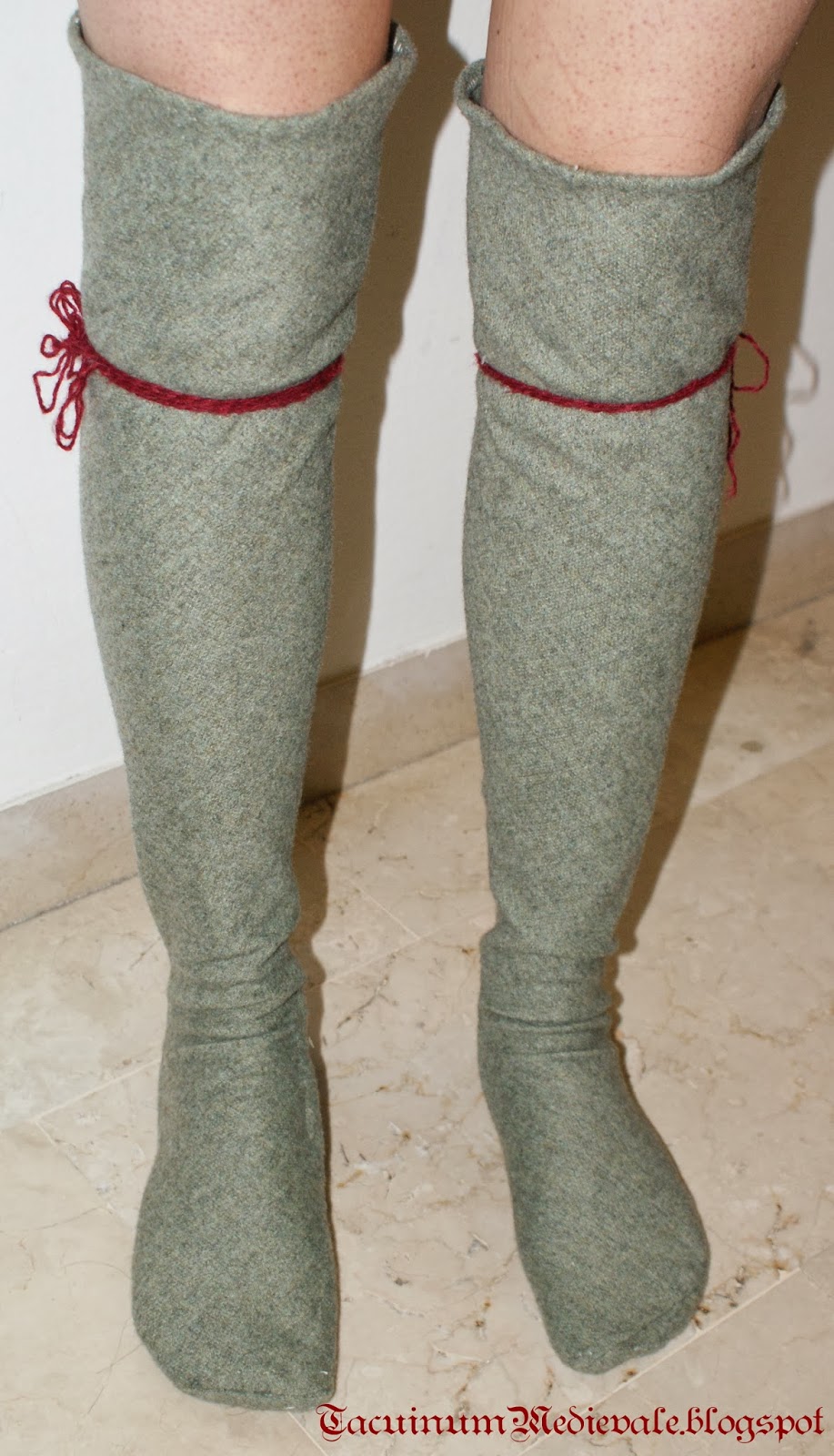
Calze terminate, mancano le giarrettiere!
Finished hoses, garters yet to come!
Il modello che ho utilizzato per le mie calze proviene dal Medieval Tailor's Assistant (pag. 104 sgg., fig. 7a): ho scelto il modello privo di cuciture sotto la pianta del piede, fidandomi, senza fare prima una ricerca, e, quando ormai le calze erano cucite, mi sono resa conto che non avevo ancora trovato un solo reperto della forma da me scelta. Per il momento mi assolvo dai miei peccati e tengo queste, quando farò le prossime sceglierò un modello documentato. L'aspetto che ritengo davvero fondamentale, tanto per le calze che per le calzabraghe da uomo, è l'aderenza, il fitting. Per ottenerlo, è importante partire da un modello personalizzato: io ho usato della stoffa di scarto e mi sono fatta aiutare a modellarla il più possibile. Riportando poi il modello sul tessuto finale,ho tagliato in diagonale il tessuto, per avere maggiore elasticità (dagli schemi del Medieval Tailor's Assistant dovrebbe risultare abbastanza chiaro il procedimento.)
Ho scelto della spessa lana grigia, per le mie calze, e ho cucito tutto a mano utilizzando del filo di lino bianco incerato. Ho usato il punto indietro per le cuciture principali, ho ribattuto tutte le cuciture usando il sottopunto (un lavoro lungo e noioso, ma utile per non avere la pressione della stoffa non ben distesa e anche per irrobustire le cuciture, evitando che la lana si sfilacci) e ho utilizzato, per i piccoli gheroni laterali, la tecnica testimoniata dai reperti della Groenlandia, cucendo cioè dal lato dritto del capo, non a rovescio. La tecnica, che a Battle of Visby abbiamo chiamato "The Perfect Gore", permette di centrare bene il gherone e di evitare i difetti che si possono verificare cucendo a rovescio. (Trovate su La Cotte Simple la spiegazione, utile per i gheroni di ogni capo d'abbigliamento)
Work in progress!
***
I finished my hoses just in time for Christmas! I should hang them near the Christmas Tree and see if Santa will leave any present for me... Actually, I've bought myself enough presents, we'll open them together when my parcel arrives.
But let's go back to my hoses - or stockings. I don't have much to say about artistic sources, because I've never seen any depiction in italian art, also because of the lack of images of women showing their legs or even their feet. A weak clue is, here and there, something coloured which can be seen inside the shoes. An interesting note comes from Rosalie's Medieval Woman
Hose, as well as socks, were worn by medieval women. Our model woman Margherita Datini's wardrobe account of 1339 lists both white linen undersocks and long hose of silk or wool. The wife of a wealthy Italian merchant, Margherita had access to commercially produced items in the town, and would have worn what regular women of her class wore. 
Obviously it would be interesting to find the document to ger more informations (ad verify the reported year, since Margherita was born in 1360 and dies in 1423...) and see also which are the original italian terms translated as "undersocks" and "hose".
Just to give you a clue of the model I had in mind while sewing my hoses, you can see a miniature from the famous Les Très Riches Heures du duc de Berry, France, about 1412: two women and a men are warming in front of the fireplace, the one at the bottom with the blue dress shows hoses reaching her knees, kept in place probably by a strap made of the same fabric (she is also showing something else, but let's not pay too much attention to it...!). The woman at the front may also be wearing light brown hoses.
L'interno del gherone. / The inside of the gore.
The model I chose for my hoses comes from the Medieval Tailor's Assistant (p. 104 and following, fig. 7a): I chose the one without seams under the foot and I admit I made no research before, so I realized only when the hoses where done that I hadn't seen any find having the shape I had chosen. For now, I absolve myself from my sins and I will keep them for a while in order to see how they're working and I will choose a proper shape for the next ones I'll make.
I think the fitting is truly important both for women's or men's hoses: to gain it, it's important to start from a personal pattern. I used scrap fabric and asked for help to make it as tight as possible. Cutting the wool, I decided to make a diagonal cut to have more elasticity (from the Medieval Tailor's Assistant schemes the process results quite clear).
Il piede il gherone visto da fuori. /
The foot and the gore.

I chose thick grey wool for the stockings and I hand-sew them using white waxed linen thread. I used backstitch for the main seams, I flattened all the seams using hem-stitch (a long and boring work, but useful to avoid messed fabric around the foot, to strenghten the garment and to prevent wool from raveling) and I used for the small "side-gores" a technique well documented by the Greenland clothes, i.e. I sew the gores from the right side, not from the wrong one. This technique, which we called "the Perfect Gore" at Battle of Visby, allows to place easily the gore in place and helps to avoid the flaws due to the wrong-side seams. On 
 
La Cotte Simple you can find useful instructions for every kind of garment.