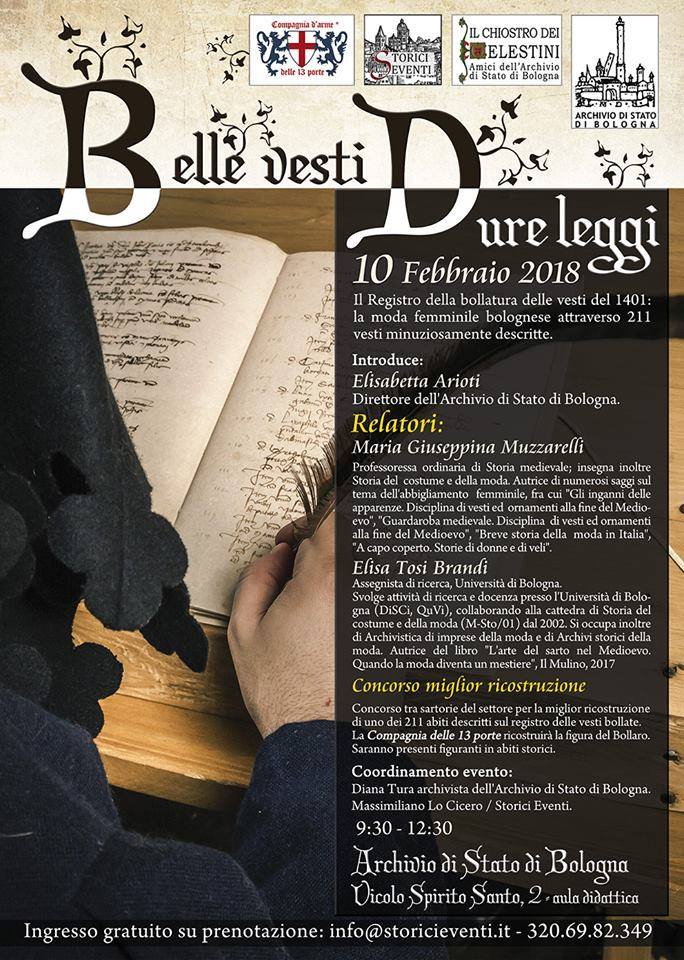
Sabato
10 febbraio si è svolta un'interessante giornata di studio e di confronto organizzata da Storici
Eventi,
in collaborazione con l'Archivio di Stato di Bologna, che ha ospitato l'evento, con l'Associazione "Il Chiostro dei Celestini" e la Compagnia
d'Arme delle 13 porte:
“Belle Vesti, Dure Leggi”, dedicato alla moda trecentesca e ad
alcune delle più interessanti fonti conservate presso l'istituto.
Sono
intervenute la prof.ssa Maria Giuseppina Muzzarelli, esperta di
storia della moda e curatrice dell'edizione delle leggi suntuarie
dell'Emilia Romagna, e la dott.ssa Elisa Tosi Brandi, ricercatrice
che da tempo si dedica anche allo studio della moda del Quattrocento
e allo studio della figura del sarto tra
medioevo e rinascimento.
Il
documento che ha ispirato l'incontro è il registro delle vesti
bollate del 1401: si tratta di un piccolo quaderno cartaceo sul quale
furono annotate, nel gennaio dell'anno 1401, 211 vesti che violavano
le leggi suntuarie recentemente emanate. La registrazione e la
conseguente apposizione di una bolla direttamente sulla veste
(probabilmente un piccolo dischetto metallico) permetteva a chi fosse
già stato in possesso di vesti ora vietate di continuare a
indossarle senza venire multato. La caratteristica straordinaria di
questa fonte bolognese sono le brevi descrizioni che integrano la
registrazione degli abiti. Da qui è nata l'idea di proporre un
concorso, nel quale 5 sarti si sarebbero sfidati nella ricostruzione
di uno degli abiti scelti dalla giuria (composta da Maria Giuseppina
Muzzarelli, Elisa Tosi Brandi, Diana Tura dell'Archivio di Stato di
Bologna, Massimiliano Lo Cicero di Storici Eventi e me): una sfida
notevole, dal momento che la principale fonte non era, come in altri
casi, una miniatura o un affresco, ma una semplice riga di testo, che
necessitava di ulteriori studi e approfondimenti per potersi
trasformare - di nuovo - in un abito.
Questi i 4 abiti scelti,
come descritti nella fonte originale:
#44. Donna Caterina di Giacomo stracciaolo della cappella di San Giorgio presentò un sacco di color monachino con maniche a mantello
#77.
Donna Zanna moglie di Pietro Domenici merciaio della cappella di san
Giuseppe presentò una cotta di panno rosato con tre cordelle
all’altezza dei piedi e profilato di vaio, con bottoni di filo
d’argento e due manicotti frappati e ornati di filo d’oro.
#78.
Donna Bettina di Giacomo di Antonio della Torre della Cappella di San
Tommaso del Mercato presentò un sacco di velluto nero con frangia di
seta nera a collo
#157.
Donna Antonia di Nicolò Caccianemici….
Inoltre
presentò un sacco a righe azzurre con maniche nere, con argento
sopra e frangia rossa.
Saturday
10th of February a very interesting meeting about 14th century
fashion took
place: “Belle Vesti, Dure Leggi”
(“Beautiful dresses, hard laws”), organized by Storici
Eventi together with the State Archive of Bologna, where the event took place, the association "Il Chiostro dei Celestini" and the Compagnia
d'Arme delle 13 porte.
Lectures were hold by professor Maria
Giuseppina Muzzarelli, expert in fashion history and curator of the
edition of the sumptuary laws of Emilia Romagna, and Elisa Tosi
Brandi, researcher in fashion history who has recently published
about 15th century fashion and tailors in
the Middle Ages. The document which inspired the meeting is a register of forbidden dresses from 1401: it's a small paper notebook with the description of 211 garments that were no longer allowed because of new sumptuary laws. The garments were brought to the city authorities by their owners, they were registered on the notebook and they were marked with a stamp (bolla – very likely a metal stamp): this way, people who already owned dresses that were now forbidden could still wear them without having to pay a fee. One of the very special features of this source are the brief descriptions given for every dress: thus we decided to organize a contest, where 5 tailors could reconstruct one of the dresses chosen from the list by the panel of judges (composed of Maria Giuseppina Muzzarelli, Elisa Tosi Brandi, Diana Tura from the State Archives of Bologna, Massimiliano Lo Cicero from Storici Eventi and me). The challenge was not an easy one: the source this time was not an enluminure or a fresco, but only a few words, that needed comparisons with other sources and much more reaserch to become a dress - again.
These are the 4 dresses among which the tailors could choose, as described in the original source:
#44. Donna Caterina wife of Giacomo stracciaiolo from the chapel of Saint George presented a monachino-coloured sacco with mantle-like sleeves.
Stracciaiolo = seller of second-hand clothes
Monachino = reddish/brownish colour
Sacco = a word used in the area of Bologna referring to a rich winter overdress often lined and decorated (most of the garments mentioned in the register are sacchi).
#77. Donna Zanna wife of Pietro Domenici haberdasher from the chapel of Saint Joseph presented a coat of pink fabric with 3 ribbons at the level of the feets and a profile of vair, with buttons made of silver thread and 2 dagged tippets and decorated with golden thread.
#78.
Donna Bettina wife of Giacomo son of Antonio from the Tower of the
Chapel of Saint Thomas of the market presented a sacco of
black velvet with a fringe of black silk on the neck.
#157.
Donna Antonia wife of Nicolò Caccianemici […] moreover presented
a sacco with light blue stripes and black sleeves,
with silver on it and red fringe.
I sarti e le ricostruzioni - The
tailors and the reconstructions
- Alessio Orlandi "Rolando Straçarolo de Bononia" - #44 - Primo classificato pari merito / Winner with equal merit
Presentazione/ Presentation: qui (Italian only)
Presentazione/ Presentation: qui (Italian only)


- Sara Trespidi "Samby May creazioni sartoriali" - #157 - Primo classificato pari merito / Winner with equal merit
Presentazione/ Presentation: qui (Italian only)
Presentazione/ Presentation: qui (Italian only)


- Alessandra Formica "AFM Sartoria" - #157


- Francesca Baldassari "Gilda Historiae" - #77
Presentazione/ Presentation: qui (Italian only)


- Anna Fedeli "Kimera Style" - #77


Tutte le foto di Tiziano Capelli: altre foto sulla pagina di Storici Eventi
Ricostruzione del Bollatore delle vesti a cura della Compagnia d'Arme delle 13 porte: qui
Ricostruzione del Bollatore delle vesti a cura della Compagnia d'Arme delle 13 porte: qui


