martedì 2 giugno 2015

I vestiti nuovi di Todeschino / Todeschino's new clothes

I vestiti nuovi di Todeschino, un lavoro a 4 mani portato avanti da me e Francesco :)
Todeschino's new clothes, a 4-hands work by me and Francesco :)


Nouvelle acquisition latine 1673, fol. 49,
end of 14th century, Milano. 

Il pourpoint o giubba
All’abito che abbiamo realizzato viene generalmente dato l’altisonante nome francese di pourpoint, termine che deriva probabilmente dal latino perpunctus, “cucito attraverso”, derivato  dalla trapuntatura che lo caratterizza (ulteriori dettagli nell’articolo di Tasha Kelly). Attestato con questo nome anche negli inventari trecenteschi in francese di casa Savoia (Pisetzky II, 33), questo capo di abbigliamento ha in Italia nomi diversi: lo si può trovare indicato come “farsetto” soprattutto in area toscana, in riferimento alla farsa, cioè all’imbottitura, che lo caratterizza, mentre nell’Italia settentrionale è più spesso chiamato “zuppa”, “zupparello”, “giubba”. Volendo individuare una ulteriore sfumatura terminologica, sembra che i farsetti siano spesso bianchi, realizzati con panno di cotone o misto, raramente indossati a vista in quanto considerati un capo intimo, mentre le giubbe sono spesso realizzate in materiali più pregiati, serici, cioè sciamito, zetanino, velluto o più spesso zendado (Pisetsky II, 33s.). La nostra “giubba” dunque è un capo maschile piuttosto ricco, diffuso in tutto il ‘300, caratterizzato da un’imbottitura solitamente di bambagia che sottolinea la figura con il petto pronunciato tipica del Trecento, ed è l’indumento al quale si attaccano le calzabraghe.

Guiron le Courtois, Milano, 1380-1390. 

The pourpoint or "giubba"
The garment we realized is usually called with the ranting name of
pourpoint, a name that probably comes from the latin perpunctus, “pierced through”, due to its typical quilting (see Tasha Kelly’s article for more details). Attested with this name also in 14th century inventories of House Savoia (Pisetzky II, 33), written in French, in Italy this garment has different names: it’s called "farsetto" mainly in Tuscany, reffering to the "farsa", i.e. the padding material, while in Northern Italy it’s more often called “zuppa”, “zupparello”, “giubba”. Searching for a more specifical meaning for this words, it seems like "farsetti" were more often white, made in cotton fabric or mixed fabric (linen/cotton), rarely worn on-sight because they were considered undergarments, while "giubbe" where usually realized in expensive materials, i.e. different kinds of silks, like "sciamito", "zetanino", velvet, or, the most common, "zendado" (Pisetzky II, 33s). So our “giubba” is a quite rich male garment to which the hoses were fastened, used through the whole 14th century, usually padded with cotton tow to emphasize the dove-like male chest, so appreciated in that period.


Il modello, i materiali e la realizzazione
Non essendomi mai confrontata con una sfida del genere, non me la sono sentita di progettare un pourpoint partendo da zero: abbiamo allora deciso di acquistare il libro di Tasha Kelly sul pourpoint di Charles de Blois, nel quale, oltre a una descrizione dettagliata dei passaggi da seguire, si trova anche il prezioso cartamodello. Una volta realizzato il provino e fatti i necessari aggiustamenti, abbiamo lasciato qualche centimetro di margine per l’imbottitura: se volete fare un calcolo più preciso, guardate qui. Abbiamo poi tagliato i singoli tessuti, sovrapposto tutti i pezzi e iniziato il lavoro di trapuntatura, prima di cucire insieme le parti. L’imbottitura è costituita da un solo strato di bambagia su tutto il corpo, mentre è doppia sul petto.
I materiali:
- lino bianco per fodera del pourpoint
- bambagia per l’imbottitura: dal reperto e dai molti statuti dei farsettai risulta che l’imbottitura dovesse essere fatta principalmente utilizzando proprio la fibra grezza del cotone.
- seta per l’esterno: è seta sottile con tessitura piana, con trama gialla (con fili più spessi) e ordito bordeaux, con circa 36-40 fili/cm: le caratteristiche della seta sono simili a quelle riscontrabili in alcuni dei reperti di Londra. 
Le cuciture interne sono realizzate in filo di lino bianco, mentre quelle visibili in filo di seta.
 

The model, the materials and the process
Since I never undertook such a challenge, I decided not to start the tailoring from the beginning. We bought Tasha Kelly’s book  about Charles de Blois pourpoint, which features the instructions and a really good pattern. We realized the toile, made some adjustments and left some extra fabric for the padding: if you want to know exactly how much fabric you have to leave, see here. We cut the different fabrics and padded them all together. The padding consists in 1 layer of cotton tow over all the body, while it’s 2 layers on the chest. 
The materials:
- White linen for the lining
- Cotton tow for the padding: from the original finds and many rules of the "farsettai" (doublet makers) guilds in Italy it’s known that cotton tow had to be used for the quilting.
- Silk for the outer layer. It’s a thin tabby silk, with a yellow warp (with thicker threads) and a Bordeaux weft, with about 36-40 threads/cm: the features of this silk are quite similar to some of the findings from London.
The inner seams are made in white linen, while the visible ones are in silk. 


Bottoni speciali 
I bottoni del pourpoint di Charles de Blois sono in stoffa o in legno ricoperto, ma per questo aspetto ci siamo distaccati dal modello, e per “semplificarci la vita”, abbiamo realizzato i bottoni noi stessi, grazie alla progettazione e sotto la guida di Nicola Tonelli di “Il Gatto e la Volpe”. A vederli, sembrano bottoni normali, ma la caratteristica che li rende speciali è che sono cavi: nascono infatti da due semisfere di lastra di bronzo, saldate insieme e completate dal gambo. Questa tipologia di bottone, anche se poco riprodotta nel mondo della rievocazione, sembra essere molto diffusa in Italia, come confermano anche alcuni ritrovamenti basso-medievali della nostra area. Nonostante i tempi di produzione siano molto più lunghi di quelli richiesti dai normali bottoni a fusione, permettono un notevole risparmio di materiale e hanno anche il vantaggio di non appesantire l’abito (ognuno dei nostri bottoni pesa meno di 1g). Sul pourpoint ne abbiamo messi 85.

Special buttons
Charles de Blois original buttons are made in fabric or have a wood core, but we decided to make them in a different way. To “make our life easier”, we made the metal buttons ourselves, thanks to the project and support of Nicola Tonelli from “Il Gatto e la Volpe” .  If you only look at them, they look like normal buttons, but their special feature is that they’re hollow: they are made from 2 hemispheres of bronze sheet, soldered together and completed with the loop. This kind of button, even if it’s not popular in the living history world, is very common in Italy, as some local late medieval finds from our area confirm. Despite the production time, that’s really longer than casted buttons, they allow to save a lot of material and don’t add much weight to the garment (every button weights less than 1g). On the pourpoint there are 85 of them! 


Le calzabraghe
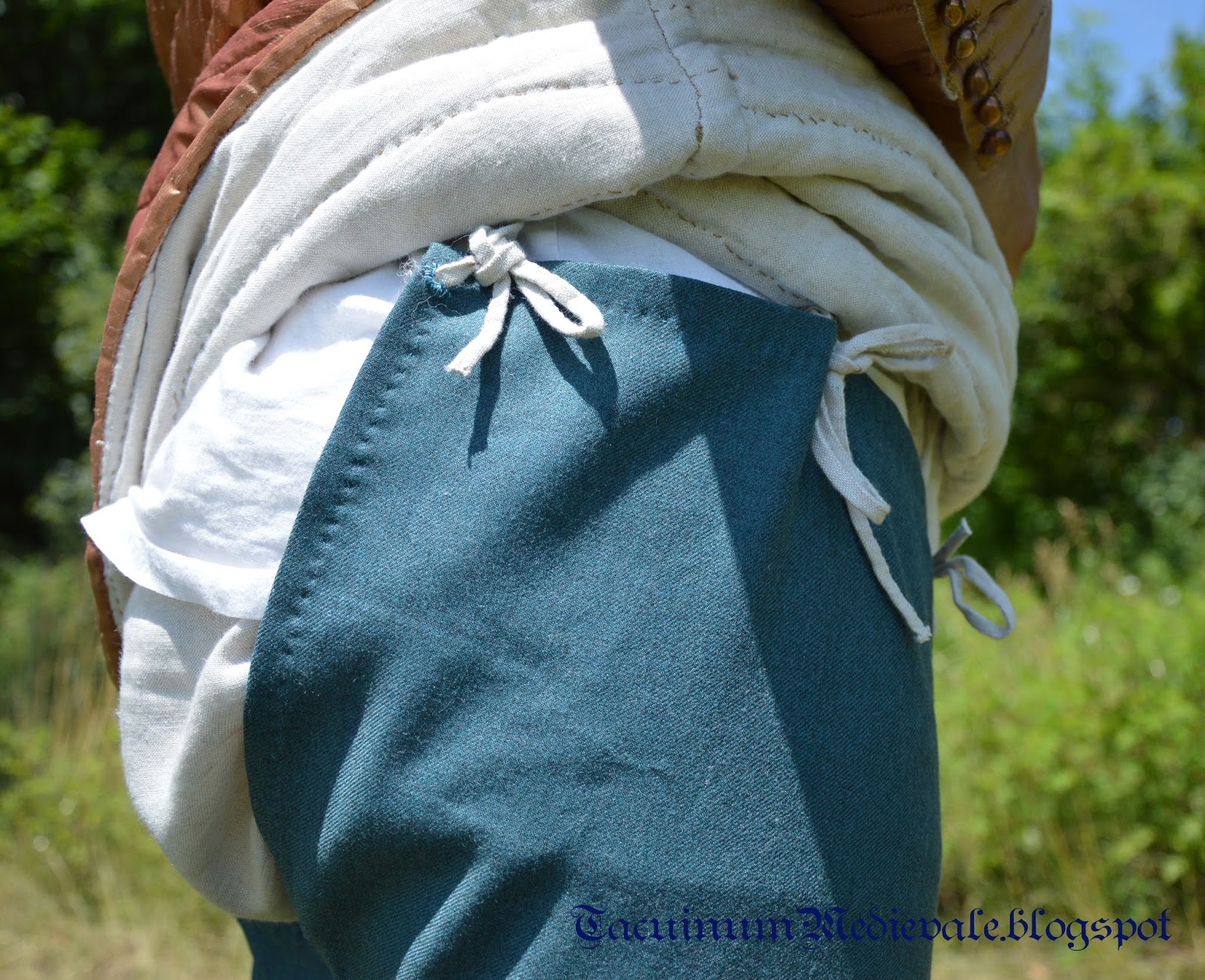
All’interno del pourpoint originale sono ancora visibili i lacci ai quali erano attaccate le calzabraghe: sono 3 per ogni lato più 1 laccio al centro della schiena di cui non abbiamo capito precisamente lo scopo (forse serviva a tenere ferme al centro le due calzabraghe?). Nonostante l’idea iniziale fosse quella di rispettare la stessa posizione dei lacci dell’originale, non siamo riusciti a riprodurla fedelmente e le nostre calzabraghe quindi non coprono che parzialmente il sedere, mentre, a giudicare dai lacci, quelle indossate da Charles de Blois dovevano coprirlo quasi interamente. Un aspetto che ritenevo importante era che tra il pourpoint, corto per sua natura, e le calzabraghe non fossero visibili le braghe, dal momento che sono spesso a vista nelle ricostruzioni ma quasi del tutto assenti nelle fonti iconografiche. Ritengo che le critiche dei moralisti dell’epoca rivolte a queste “braghe” a vista siano più che altro da intendere come critica all’accorciarsi progressivo delle vesti a cui si assistè nella seconda metà del secolo, ma non ritengo che le braghe a vista fossero di per sè un elemento apprezzato, data la loro quasi completa assenza nell’iconografia (quando sono presenti inoltre identificano personaggi poveri, con gli abiti laceri). Per ottenere la massima aderenza possibile della calzabraga alla gamba, abbiamo tagliato la lana di sbieco, ma non essendo sufficientemente elastica abbiamo dovuto lasciare aperta la cucitura della parte inferiore del polpaccio, che viene dunque cucita ogni volta che le si indossa: pur non essendo una soluzione ottimale, non ci è sembrata del tutto improbabile, dal momento che la cucitura non è un processo così lungo come potrebbe sembrare (non più di un paio di minuti) e che alcuni reperti della Groenlandia presentano comunque un’apertura dietro la caviglia, probabilmente per facilitare il passaggio del tallone. In ogni caso, molto probabilmente questo stratagemma può essere evitato utilizzando un twill o una lana più cedevole. La forma del piede è basata sui reperti di Londra e su alcune fonti italiane.


Hoses
Inside the original pourpoint are still visible the laces used to fasten the hoses: there are 3 on each side plus 1 in the middle of the back (we are not sure about its purpose, but maybe it was used to fasten both hoses together in the middle?). Despite the first aim was to reproduce the original placing of the original garment, we didn’t manage to and our hoses only cover the bottom partially, while, considering the placing of the original laces, Charles’ hoses must have covered his bottom almost completely. I wanted the braies not to be visible when wearing the short pourpoint and hoses: you can often see them during the living history events, but are never shown in pictures. I believe that the moralists who criticized these “visible braies” should be considered as a critic towards the upper clothes becoming shorter and shorter during the 2nd half of the century, but I don’t believe visible braies were themselves an appreciated element of fashion, since they are almost completely absent from sources (and also when they are shown they identify poor characters in rags). To have the hoses as fitted as possibile, we cut the fabric on the bias, but since it wasn’t enough stretchy we had to leave the seam open in the lower part of the calf, that is therefore sewn-on every time they are worn: even if it’s not the perfect solution, it didn’t seem completely impossible to us, since the sewing only requires a couple of minutes and some of the Greenland finds show an opening behind the ankle, probably to help the heel pass trough. Anyway, this opening would probably be unnecessary using a twill or a more elastic wool. The shape of the foot is based on the finds from London and some Italian sources. 

Le scarpe sono di Graziano Dal Barco / The shoes are made by Graziano dal Barco 


 Riferimenti e articoli correlati / References and related articles

Tasha Kelly:
Il libro di Tasha Kelly “The Pourpoint of Charles de Blois” / Tasha Kelly’s book “The Pourpoint of Charles de Blois” 

Altro / Other
La pagina dedicata a Todeschino sul nostro sito / The page about Todeschino in our website
Forum con discussione sulle calzabraghe e come evitare le braghe “a pannolone” / Forum with discussion about hoses and how to avoid “diaper look”.
Il Gatto e la Volpe”, riproduzioni storiche di oggetti metallici / “Il Gatto e la Volpe”, historical reproductions of metal items 


domenica 15 marzo 2015

The Manuscript Challenge: il vestito blu dal Tacuinum Sanitatis / The Blue Dress from the Tacuinum Sanitatis


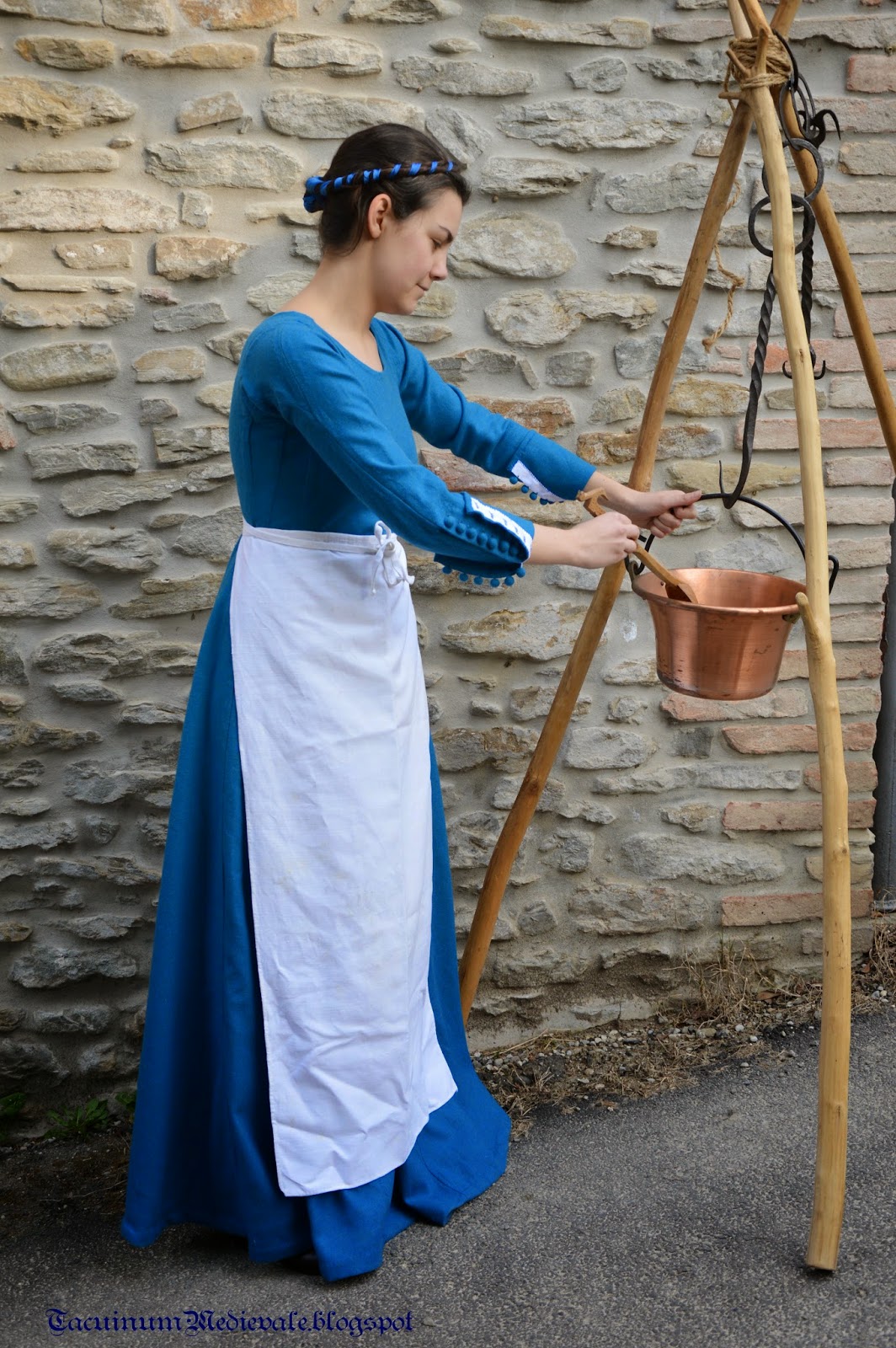
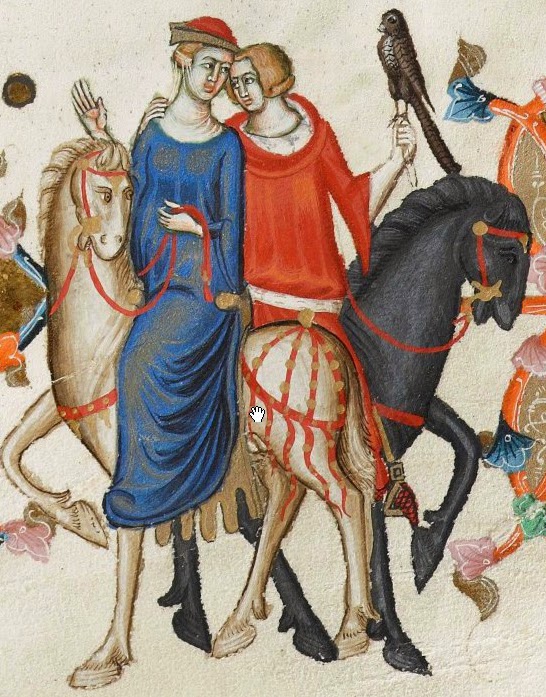
L'abito blu, basato sul Theatrum Sanitatis from Biblioteca Casanatense, Ms.4182, tav.117, ricostruito per la Manuscript Challenge, è finalmente completato: qui trovate tutte le informazioni sulla sua realizzazione.
Il modello
Ho deciso di utilizzare il modello ricavato dai reperti della Groenlandia Norlund 1b, prendendo come principale riferimento il reperto D10584 (Norlund n.42). Nonostante i dubbi riguardo all’uso di
Il primo modello con le "princess
seams". / the first toile with
the "princess seams"
modelli nordici per la moda europea ed italiana (1), ritengo comunque che sia accettabile l’utilizzo di questi reperti come riferimenti, sia perchè sono tra le pochissime fonti archeologiche disponibili, sia perché, con le necessarie modifiche, si prestano ad adattarsi anche allo stile continentale.
Il modello è composto da due parti principali, una anteriore e uno posteriore, ai quali sono aggiunti due pannelli su ogni lato e due gheroni centrali, uno anteriore e uno posteriore. Uno degli aspetti principali della sfida è stato dimostrare che è possibile realizzare un abito aderente come quelli presenti nell’arte figurativa del periodo senza allacciature o abbottonature sul busto: è stato possibile farlo grazie al tipo di lana, un twill 2/2, che, probabilmente proprio per questa sua caratteristica elasticità che lo rende adatto ad abiti aderenti, è uno dei tipi di tessuto più diffusi del Trecento.
Ho iniziato realizzando un modello di prova di un sottile tessuto di cotone: nonostante il risultato fosse piuttosto soddisfacente dal punto di vista del fitting, discutendone sul gruppo Facebook della “Manuscript Challenge” mi è stato fatto notare che i miei pannelli laterali erano nettamente più larghi (7-8cm) del reperto originale e andavano ad allargarsi sul seno formando le “princess seams”, cioè cuciture moderne, ben diverse come forma da quelle della Groenlandia. Ho rifatto un secondo modello, riducendo i pannelli laterali a 5 cm e dandogli una forma più rettangolare, come i reperti, in modo che le cuciture rimanessero sotto le braccia e non modificassero la linea del busto. A questo punto ho trasferito il modello su carta e ho infine tagliato la stoffa: una volta imbastito il modello, sono riuscita a renderlo ancora più aderente grazie all’elasticità del tessuto. Il gherone frontale parte poco sotto lo sterno, all’altezza dello stomaco, mentre quello posteriore è attaccato leggermente più in basso. L’ampiezza all’orlo è di circa 4 metri.
Le maniche hanno di base una struttura rettangolare, nella quale ho inserito un triangolo sulla spalla per garantire una buona mobilità: sono poi state modellate sul braccio e sull’avambraccio per renderle aderenti ma comunque confortevoli.

The blue dress from 
Theatrum Sanitatis from Biblioteca Casanatense, Ms.4182, tav.117 reconstructed for The Manuscript Challenge is finally complete: find out more about its construction here. 
The model
I decided to use the model from Greenland finds Norlund 1b, and chose as main reference the garment D10584 (Norlund n. 42). Despite of the doubts about the use of Greenlandic shapes for European and Italian fashion (1), I believe it’s acceptable to use these finds, because they are amongst the very few available sources and also because, with the necessary changes, they can be adapted to the continental fashion.

I pannelli laterali corretti. /
The fixed side panels.
The model is made with 2 main pieces, front and back, plus 2 panels on each side and 2 central gores, one on the front and one on the back. One of the main “challenges in the challenge” was to demonstrate it’s possible to make a fitted garments, as the ones shown in period pictures, without any lacing or buttoning on the body: it was possible to make it thanks to the wool, a 2/2 twill, which is a very common kind of fabric in the 14th century, due to its elasticity which is very useful to make fitted garments.
I started to make a toile with a thin cotton fabric: despite the fitting was quite satisfying, while discussing it on the Facebook group of the “Manuscript Challenge” it was pointed out that my side panels were definetly larger (7-8 cm) than the original ones and that they were even larger on the breast becoming the so-called “princess seams”, modern seams, totally different from the medieval ones. I started again and made a new toile, reducing the dimension of the side panels (5 cm) and giving them a more rectangular shape, as the finds, so that the seams stayed under the armpit and didn’t modify the shape of the body. Once happy with it, I drew the pattern on paper and cut the fabric. Once basted, I was able to fit it even more thanks to the elasticity of the twill. The front gore starts from the breastbone, on the stomach, while the back one it’s a little lower. The hem is 4m.
The sleeves are based on a rectangular pattern, in which it was inserted a triangular gore to have a good mobility: they were modelled on the arm and forearm to make them fitted but comfortable.


Attaccando il gherone. /
Sewing the gore.
Cuciture (in filo di lino blu)- Punto indietro e punto filza: ho utilizzato il punto indietro per attaccare i pannelli principali e quelli laterali dalle ascelle ai fianchi, mentre per la parte inferiore della gonna ho ritenuto sufficiente usare il punto filza (con punti molto piccoli, non ce n’è nessuno più lungo di 3-4 mm, like the originals). Il punto indietro è stato utilizzato anche per le maniche e per unire i due triangoli che compongono i gheroni anteriore e posteriore: uno dei due ha una finta cucitura, come quelle presenti su alcuni dei reperti.
- Punti dati dall’esterno per attaccare i gheroni. Questa cucitura si trova nei reperti della Groenlandia e permette di attaccarli in modo molto pulito e stabile.
- Sottopunto per rifinire le maniche e l’orlo.
- Rifinitura delle cuciture principali: ogni cucitura è stata stirata e schiacciata. Le cuciture dei fianchi sono state ripiegate su un lato, solo quelle delle maniche sono state aperte al centro e ripiegate su entrambi i lati. In tutte le cuciture è stato utilizzato un doppio filo di riempimento di lana perché il twill tende a sfilacciarsi molto: questa è stata senza dubbio la parte più lunga del lavoro, ma fondamentale per garantire la sua durata.
- Asole e bottoni: sull’abbottonatura ho inserito due strisce di rinforzo di lino, con circa 17-18 fili/cm. In alcuni reperti è stata trovata traccia di un rinforzo solo sul lato delle asole, ma sulla scorta di un affresco di Pomposa ho deciso di applicarla su entrambi i lati. I bottoni sono ricavati da quadratini di lana 4x4cm e cuciti con filo di seta, le asole sono fatte in filo di seta e hanno forma rettangolare.


Affresco dall'Abbazia di Pomposa, 1a metà XIV secolo. /
Fresco from Pomposa Abbey, 1st half 14th century.
Asole, bottoni e rinforzo in lino. / Buttons, buttonholes and linen facing.
Cucitura con filo di riempimento. /
Seam with filler thread.
Seams (in blue linen thread)
- Backstitch and running stitch. I used backstitch to join the main panels and the side panels from the armpit to the hips, while in the lower part of the skirt I decided the running stitch was strong enough (I used very tiny stitches, no longer than 3-4 mm, as the originals). I chose the backstitch also for the sleeves and to join the triangles which make the front and back gores: one of them includes a false seam, like in some of the preserved garments.
- External stitches to sew the gores. This kind of stitch is found on Greenlandic garments (and London???) and allows to attach them in a very clean and strong way.
- Hemming stitch for the hem and the sleeves.
- Finishing of the seams: every seam has been ironed and pressed. The side seams have been pressed on one side, only the ones on the sleeves have been split open in the middle and finished on both sides. I put a double woolen filler thread in every seam because this twill frayed a lot: this was certainly the most time consuming part of the work, but it was necessary to make it durable.
- Buttons and buttonholes: on the buttoning I decided to put 2 facings in linen, a densely woven fabric with 17-18 threads/cm to reinforce it. In some garments it was found a facing only on the buttonholes side, but I decided to put it on both sides, after a fresco from Pomposa. The buttons are completely in woolen fabric, from squares 4x4cm and sewn in silk thread; the buttonholes are made with silk thread and are box-shaped.

Pettinatura e altri elementi
Già alla fine dell’estate avevo fatto alcuni esperimenti per trovare una pettinatura compatibile con quella della mia miniatura: alla fine ho optato per una coda divisa in due parti e direttamente cucita sui capelli con un nastrino di seta, seguendo questo tutorial
L’abito è un primo strato, quindi lo indosso solo sopra la camisa supportiva di cui ho modificato la scollatura in modo che non si vedesse sotto il vestito, con le mie calze e le scarpe realizzate da Graziano Dal Barco. La donna della miniatura indossa anche un grembiule, per il quale ho usato quello fatto l’anno scorso

Hairstyle and other elements
Since the end of summer I started to make experiments to find a suitable hairstyle: in the end, I decided to go for a split ponytail directly sewn to the hair with a silk ribbon, following this tutorial
The dress is a first layer, so I wear it over the supportive underwear
(to which I changed the neckline to hide it under the blue dress), with my hoses and the shoes made by Graziano Dal Barco. The woman in the miniature wears also an apron, like the one I made last year.

Solo per divertimento :) Grazie a Francesco per aver elaborato la miniatura!
Just for fun :) Thanks to Francesco for editing the miniature!
Ringraziamenti:
Sono state moltissime le persone che mi hanno aiutata nella realizzazione di questo abito: grazie in primo luogo a Giulia, Giorgia e Vito che mi hanno regalato la lana e hanno seguito con trepidazione ogni fase, a Francesco per avermi aiutata nel modellare il vestito, a Nini per tutti i consigli sartoriali che mi ha generosamente dispensato nel corso dei mesi, a Margherita per l’aiuto a realizzare la pettinatura giusta, a Maria Neijman, Mary e tutti gli altri partecipanti della Manuscript Challenge che sono sempre stati di grande aiuto. Tutti gli errori e le imprecisioni sono naturalmente da imputare a me solamente. 
Questo vestito è dedicato alla memoria della mia nonna Maria (15.09.1931-3.3.2015): le nostre ultime ore felici insieme sono cucite qui. 
Thanks
There are many people who helped me while making this dress: first thanks to Giulia, Giorgia and Vito who gave me the wool as a gift and followed every step, to Francesco who helped me fitting the dress, to Nini who answered my questions and gave me a lot of useful suggestions during these past months, to Margherita who helped me to realize the proper hairstyle, to Maria, Mary and all the other participants of the Manuscript Challenge for their support. All the mistakes are of course all my fault.

This dress is in loving memory of my grandmother Maria (15.09.1931-3.3.2015): our last peaceful hours together are sewn here. 

Riferimenti bibliografici / References
(1) - The View from Herjolfsnes: Greenland's Translation of the European Fitted Fashion, R. Netherton, Medieval Clothing and Textiles, Volume 4, 143-173.
2 Woven into the Earth: Textile finds in Norse Greenland, Else Ostergaard
3 Medieval Garments Reconstructed: Norse Clothing Patterns, by Lilli Fransen, Shelly Nordtorp-Madson, Anna Norgard, Else Ostergard

venerdì 5 dicembre 2014

Il cappello a punta nell'abbigliamento femminile / The bycocket in women's garb

- Il cappello a punta: un copricapo molto diffuso
1a metà XIV sec, Bologna.
San Pietro benedicente e donatore in
veste di pellegrino da (Fondazione Zeri) /
1st half of 14th century, Bologna.
Blessing Saint Peter and donor, 
1338-1340 Ambrogio Lorenzetti,
Siena: Allegoria dell'Inverno
Allegory of Winter
Il “cappello a punta”, di una foggia così diffusa nel Trecento e dal nome così sfuggente, è da tempo diffuso nel mondo della rievocazione come accessorio maschile, ma  la sua popolarità anche come accessorio femminile è in crescita.In mancanza di documentazione di un termine italiano coevo per designare questo cappello, mi limiterò a chiamarlo “cappello a punta”, ricordando che in inglese è anche chiamato “bycocket” e che in francese può essere definito anche “chapel à bec” (non serve ricordare che nell’immaginario collettivo è “il cappello di Robin Hood”). Le attestazioni di questo tipo di cappello, indossato da personaggi maschili, sono estremamente numerose nell’iconografia trecentesca (ne potete vedere alcune su Larsdatter). Sembra essere particolarmente frequente nella rappresentazione di scene di caccia (ne parlano qui gli amici di Exploring the Medieval Hunt) ma compare anche come elemento ricorrente nelle scene di viaggio: è infatti il tipico cappello da pellegrino, a volte decorato dalla conchiglia, ed è spesso indossato da personaggi ritratti in climi avversi o piovosi. Sono forse meno frequenti, ma non assenti, le scene in cui questo cappello completa un abbigliamento elegante (particolarmente presenti nel Tacuinum Sanitatis di Pavia o Milano, Nouvelle acquisition latine 1673), a volte arricchito da inserti in stoffe contrastanti o piume.

- The pointed hat: a very common headwear
Theatrum Sanitatis: Ms.4182 tav.129
Scena di caccia / Hunting scene
Nouvelle acquisition latine 1673,
fol. 20: abbigliamento elegante con
cappello a punta / elegant clothing
with bycocket. 
The “pointed hat” it’s very common in the 14th century and has also a very elusive name: it’s been a well known male headwear in re-enactment for a while, but its popularity as a female accessory it’s growing more and more. Lacking period documentation of a proper Italian name for this hat, I will call it “cappello a punta” (pointed hat), but remember in English is also called “bycocket” and in French “chapel à bec” (it’s not necessary to remember that it’s commonly called “the Robin Hood hat”). There are many examples of male characters wearing this kind of hat in 14th century figurative art (you can find some here on Larsdatter). It seems very common in hunting scenes (my friends from Medieval Hunt talk about it here) but appears also in travelling scenes: it’s actually the typical pilgrim hat, sometimes decorated with the shell, and it’s also worn commonly by characters represented in bad weather conditions. Probably are less frequent, but not totally absent, scenes where this hat comes with elegant clothing (expecially in the Tacuinum Sanitatis from Pavia or Milan, Nouvelle acquisition latine 1673), sometimes decorated with contrasting fabric inserts or feathers.

- Il cappello a punta nell’abbigliamento femminile
1336-41, Buffalmacco, Anacoreti nella Tebaide, Pisa
Cosa dire invece dell’uso del cappello a punta da parte delle donne? Da quanto è emerso dall’iconografia e da studi precedenti, sembra che questo cappello fosse utilizzato dalle donne in circostanze ben precise. L’unica analisi in un testo di storia del costume che ho potuto individuare è quella di R. L. Pisetzky (Storia del Costume in Italia, vol. II, 1964-69, p. 118) che, a proposito dei copricapi femminili, dice:
 “Spesso sopra il cappuccio, quando non è foderato di pelliccia, e anche su altre acconciature, le donne come gli uomini portano, in viaggio o cavalcando, il pesante cappello a tese rialzate”
 e rimanda alla tavola illustrata 54, dove commenta l’affresco pisano degli “Anacoreti nella Tebaide”: 
“la bizzarria sgarbata del cappello maschile, a cupola alta e a tese risvoltate – usato anche dalle donne, di solito in viaggio o per cavalcare – acquista un fascino ambiguo, accompagnato dal soggolo trasparente, in capo alla bella ignota che nello sguardo tentatore, ancor più che nelle zampe artigliate, rivela la sua essenza diabolica”. 
1340, Bibbia Angioina
1340, Angioina Bible
Oltre a rilevare l’assenza di iconografie che mostrino donne indossare il cappello con sotto il cappuccio (a meno che con “cappuccio” non si intenda il mantello con cappuccio), forse sembra eccessiva la critica di questo accessorio nel commento della Pisetzky: la scena in analisi sicuramente mostra una donna mostruosa, ma non credo che questo carattere “demoniaco” sia proprio del cappello, dal momento che in tutte le altre scene risulta privo di ogni connotazione negativa.
Non ho resistito all’idea di realizzare una tabella per illustrare i risultati della ricerca iconografica che ho compiuto, certo non esaustiva ma svolta su numerose fonti italiane, francesi e inglesi. 
Una fonte particolarmente interessante sono stati gli “avori gotici”, visibili su questo sito: Gothic Ivories  (se siete interessati a visionare in dettaglio le schede e le foto in alta risoluzione degli avori che ho qui analizzato, vi basterà inserire nel motore di ricerca il numero di inventario nella barra di ricerca), ma anche tra le opere d’arte italiane prodotte tra gli anni ’40 e la fine del Trecento sono emerse ulteriori significative attestazioni. 

Le scene in cui sono inserite queste donne con cappello risultano di due tipi.
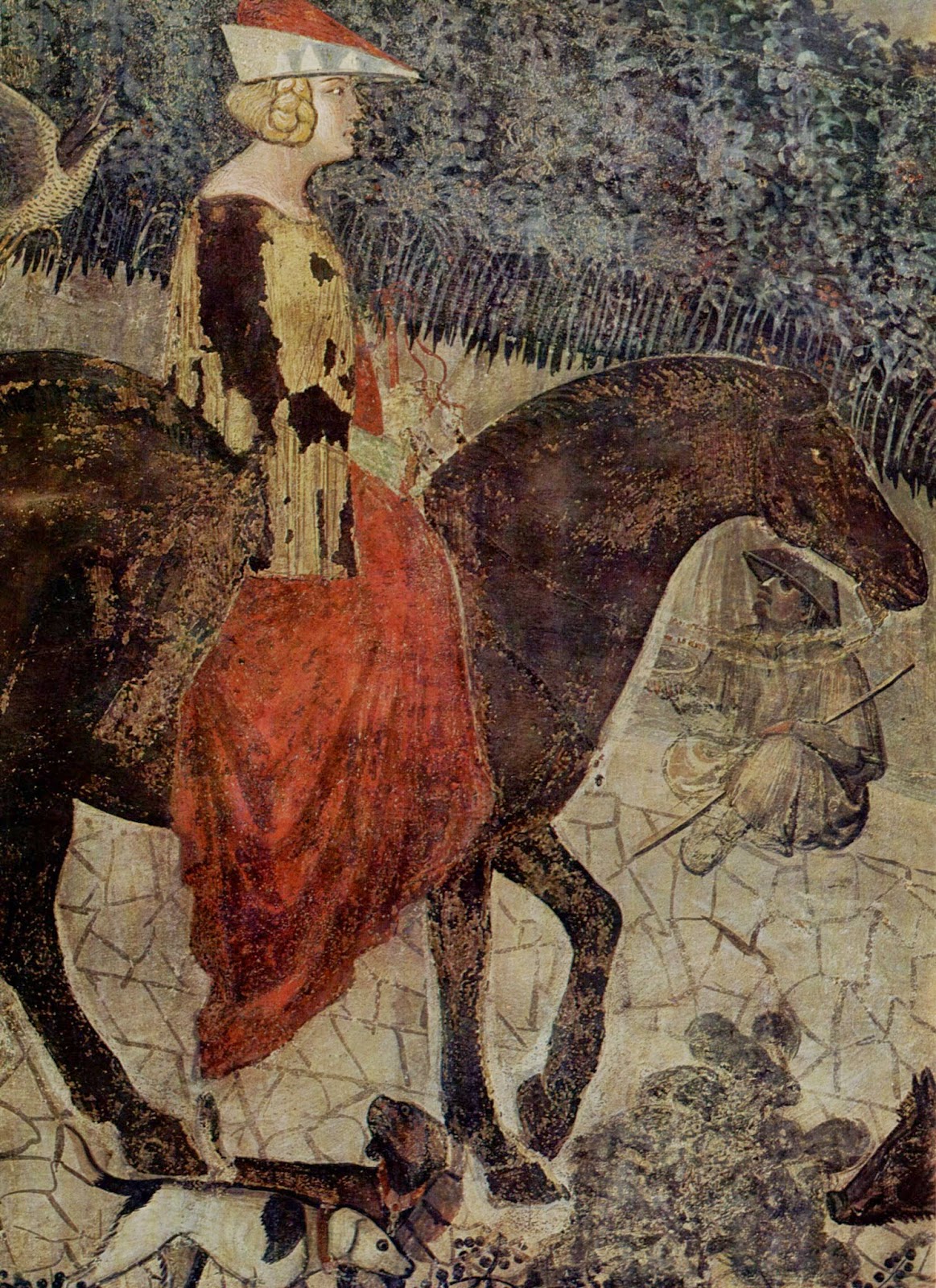
* Le scene di caccia, che risultano essere la maggioranza (14/19). Essendo un tema legato alla rappresentazione dell’amore cortese, è molto ben documentato dalla serie degli avori gotici, di produzione francese e risalenti prevalentemente alla prima metà del XIV secolo. Altre scene di caccia sono rappresentate nel noto ciclo degli “Affreschi del buon governo” dipinto a Siena da Ambrogio Lorenzetti, in cui, nell’allegoria del buon governo in campagna, è posta in primo piano una dama con il cappello. Negli affreschi del Camposanto di Pisa, sempre risalenti alla prima metà del XIV secolo, compaiono vicine 2 donne con il cappello, accanto alle quali è possibile vedere uomini con i falchi. 
1380, Agnolo Gaddi, Storie della Vera Croce, Firenze
1380, Agnolo Gaddi, discovery of the True Cross
* Le scene di viaggio. Meno rappresentate, ma comunque significative, sono le donne in viaggio: negli affreschi di San Gimignano, opera di Bartolo di Fredi, compare due volte Lot (in groppa a un cammello) con il cappello a punta, mentre un’altra donna lo indossa nella scena dell’attraversamento del Mar Rosso. Anche la “bella ignota” della Pisetzsky può essere considerata una donna in viaggio. Molto diversa da questo personaggio, eppure abbigliata in modo simile, risulta la regina Elena, raffigurata di una bellezza immortale da Agnolo Gaddi nella Chiesa di S. Croce, a Firenze: Elena, giunta fino in Terrrasanta per ritrovare la croce di Cristo, può ragionevolmente essere rappresentata come una viaggiatrice (o eventualmente una pellegrina). Se questo cappello è dunque attributo della regina Elena, risulta difficile pensare che possa di per sè presentare una connotazione negativa o troppo mascolina se indossato da una donna.Il cappello a punta ha probabilmente la forte funzione pratica di riparare dal sole e dalla pioggia, ed è dunque sempre associato a momenti di vita all’aria aperta, in particolare alla caccia e al viaggio: infatti non sono mai raffigurate donne di città o di campagna che lo indossano nello svolgimento delle mansioni quotidiane, nè tantomeno sembra fosse indossato da donne nobili o facoltose in occasioni mondane, in cui probabilmente erano preferite acconciature arricchite da pietre preziose o costosi veli di seta.

- The bycocket in female’s garb


What can we say about women using bycocket? From what came to light from iconography and previous studies, it seems likely that this hat was used by women only in clear-cut circumstances. The only analysis I could find in a book about history of costume was by R. L. Pisetzky (Storia del Costume in Italia, vol. II, 1964-69, p. 118) who says about female hats: 

1367, Bartolo di Fredi, Attraversamento del Mar Rosso
1367, Bartolo di Fredi, Crossing of the Red Sea, 
“Often, over the hood, when it’s not lined in fur, and also with other hairdressings, women, like men, wear the heavy hat with lifted-up brims when travelling or hunting”. 
She talks again of this hat in the illustrated table 54 and comments the fresco from Pisa of the “Anacoreti della Tebaide”: 
“the rude oddity of the masculine hat, with a high calotte and lifted-up brims – used also by women, usually when travelling or horse-riding – gains an ambiguous appeal, together with the transparent wimple, worn by the beautiful stranger who, in her tantalizing gaze even more than in her claws, reveals her diabolic essence”. 
1336-40, Buffalmacco,  trionfo della morte,
 1336-40, Buffalmacco, Triumph of Death. Pisa
I have to underline I wasn’t able to find any source showing women wearing hoods with the bycocket (unless with “hood” is meant a cloack with a hood) and I would also like to point out that in her comment Pisetzky seems to criticize too much this hat: in the analyzed scene the woman surely has monstrous features, but I don’t think the hat itself has any diabolic meaning, since in all other scenes it lacks of any negative characteristic. 

I couldn’t help myself and I had to make a table to show the results of my iconographical research: I can’t say I have seen all the possible sources, but I’ve been through quite a lot if Italian, French and English representations. You can see the table here.
London, The British Museum
1878,1101.40
A very interesting source are the gothic ivories, collected on this website: Gothic Ivories (if you wish to see more details or the high-quality pictures of the ivories I analyzed, you can just insert their inventory number in the “search” line), but I found other interesting depictions also amongst Italian sources from the 1340s to the end of the century.
The scenes where women wear pointed hats are of two kinds:
- Hunting scenes (14/19). Since hunt is a theme strongly connected to courtly love, it’s very well attested in the gothic ivories, carved in France in the first half of the 14th century. Other hunting scenes can be found in the “Frescoes of the good government” by Ambrogio Lorenzetti, where a lady with a pointed hat is portrayed in the allegory of good government in the countryside. Also in the frescoes from the Camposanto of Pisa (first half of 14th century) 2 women with bycocket are represented together with men holding hawks. 
1367, Bartolo di Fredi, Abramo e Lot si separano
nella terra di Cana,
1367, Bartolo di Fredi, Abraham and Lot separate
in the Land of Canaan'
- Travel scenes (5/19). Travelling women are less represented but very significant: in the frescoes by Bartolo di Fredi Lot appears twice (riding a camel) with the bycocket, while it’s worn by a different woman in the crossing of the Red Sea. Also the “beautiful stranger” described by Pisetzsky can be considered a travelling woman: queen Elena, in Agnolo Gaddi’s frescoes about the discovery of the True Cross (Florence, Santa Croce church), is clearly a woman of a completely different kind, but wears similar garments. Saint Elena, who travelled to Jerusalem to find the True Cross, can reasonably be painted as a traveler (or, eventually, as a pilgrim). If this hat is attributed to queen Elena as well, it seems hard to believe bycocket has itself a negative feature or is too masculine to be worn by women. 
The bycocket has a strong practical purpose to protect by sun and rain, and it’s therefore always connected to open-air scenes, mainly travels or hunting: women living in the cities or in the countryside are never represented with this hat while attending their daily tasks, nor it seems likely it was worn my noble or wealthy women in mundane occasions, where elaborate hairstyles and expensive silk veils were probably preferred. 

- Veli e pettinature insieme al cappello a punta
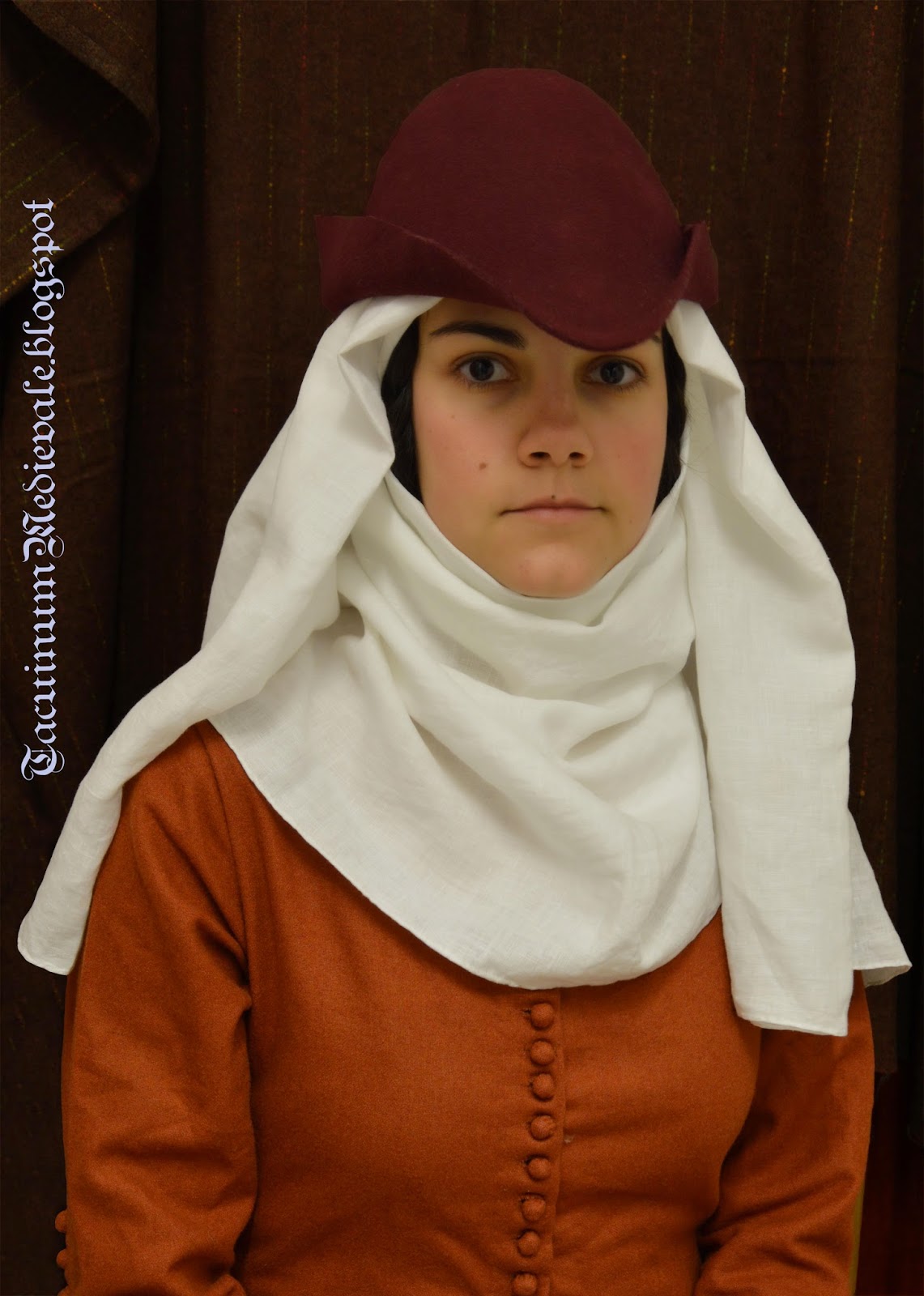
Dalle immagini si può vedere che il cappello a punta è raramente indossato da solo, ma è spesso accompagnato dal velo e/o dal soggolo, che insieme al cappello offrono una protezione ottimale dagli agenti atmosferici, possono riparare dalla polvere e rappresentano comunque un tocco di femminilità. Tra i diversi “outfit” rappresentati nelle immagini, ho scelto i 3 che preferisco di cui proporre la ricostruzione. 
-  Veils and hairstyles with the bycocket
From the sources it’s possible to see that the pointed hat is rarely worn alone, but it’s often worn with a veil and/or wimple, that together with the hat offer a perfect protection from sun, rain and dust and, nonetheless, give the outfit a touch of femininity. 
I chose my 3 favorite outfits to reproduce. 

Stile 1: L’allegoria del buon governo (trecce)
1344, Ambrogio Lorenzetti, Affreschi del buon governo,Siena 
Style 1: The Good Government (braids)
1344, Ambrogio Lorenzetti, Good government, Siena


La donna di questo celebre affresco è l’unica che ho trovato che non indossa nè il velo nè il soggolo. Ipotizzando una pettinatura simmetrica, così frequente in tante fonti coeve, la donna porta i capelli raccolti in due trecce, che sembrano essere fatte a partire dalla nuca (non dalle tempie), portate in avanti sulle orecchie, ai lati del viso, e probabilmente fissate sulla testa, sotto il cappello (suggerimento: le trecce possono essere fissate “cucendole” con un ago grosso e del filo di lana direttamente ai capelli sottostanti).
Note: Nel caso non si volesse indossare il velo, questa pettinatura è l’unica attestata abbinata al cappello a punta: i capelli sciolti, una treccia che ricade sulla schiena o una treccia che scende sulla spalla sono forse pettinature che sposano meglio il gusto moderno ma non sono mai attestate, anche perché potrebbero essere poco pratiche durante la caccia o il viaggio. 

This woman is the only one I could find who doesn’t wear veil or wimple. I suppose she wears a symmetric hairstyle, frequent in many period sources: I think she has 2 plaits that look like starting from the nape (not from the temples), pulled ahead over the ears, framing the face. They may be fastened on top of the head, under the hat (tip: braids can be sewn directly on the hair with a thick blunt needle and some wool thread). 
Note: In case you don’t want to wear a veil, this hairstyle is the only one attested together with the pointed hat: untied hair or a single braid over the back or over the shoulder can maybe match better modern taste but are not represented in period sources, also because may not be convenient while hunting or travelling.

Stile 2: Il trionfo della morte (trecce, velo, soggolo)1336-40, Buffalmacco, Trionfo della morte, Pisa
Style 2: The Triumph of Death (braids, veil, wimple)
1336-40, Buffalmacco, Triumph of Death, Pisa


Questa combinazione presenta sicuramente un’ottima protezione da pioggia, vento e sole. I capelli si intravedono appena sotto il velo: ho iniziato perciò facendo due trecce che partono dalle tempie (possono partire anche dalla nuca, ma io trovo più comoda questa soluzione) e le ho fissate dietro la testa. Da questo punto in poi, è possibile seguire il tutorial di Neulakko (tralasciando le trecce finte, se non le avete). Anche io ho indossato la mia cuffia di S. Brigida, elemento fondamentale a cui attaccare i veli: ho poi indossato il soggolo (il mio è un rettangolo di lino di circa 80cmx60cm) ripiegandolo leggermente sotto il mento, andando poi a fissarlo con 2 spilli dietro la testa e tirandolo un po’, dal momento che tende a cedere. A questo punto ho indossato il velo vero e proprio (il mio è un rettangolo leggermente stondato di circa 100cmx70cm, ma consiglio la forma a semicerchio), fissandolo alla cuffia con uno spillo al centro della fronte: si possono aggiungere con altri 2 spilli all’altezza delle tempie e ripiegare leggermente la stoffa per farlo aderire meglio al viso o tenerlo più libero e metterlo in posizione semplicemente con il cappello. 
Note: In molti casi in cui al cappello sono abbinati velo e soggolo i capelli non sono visibili, per cui è difficile stabilire quale sia l’acconciatura sottostante, anche se spesso sembra che si possa intuire la presenza delle due trecce sotto il velo. In alcuni casi, in particolare negli avori, i capelli sono rappresentati come delle piccole “onde” che non indicano una pettinatura precisa, ma ritengo sia comunque da escludere l’ipotesi che i capelli siano portati sciolti sotto al velo, dal momento che questa soluzione non compare mai nemmeno in altri contesti: potrebbero forse essere delle piccole ciocche sfuggenti. 
Al posto del soggolo di lino, se ne può indossare uno di seta per uno stile simile a quello di Sant’Elena negli affreschi di Santa Croce di Agnolo Gaddi. 


This combination offers a very good protection from sun, rain and wind. The hair are barely visible under the veil, so I started making 2 braids starting from the temples (they can start from the nape as well, but I find the first solution more comfortable) and I fastened them behind the head. From now on, you can find Neulakko’s tutorial  (skip fake braids if you don’t have). I wore my Saint Brigit’s cap and then the wimple (mine is a linen rectangle, 80cmx60cm), folding it a bit under the chin and pinning it behind the head: pull it well since it loosens a bit. At this point I put on the veil (a linen rectangle with rounded edges, 100cmx70cm: choose a half-circle shape if you can), pinning it to the cap with a pin in the center of the forehead: you can add 2 more pins over the temples and fold the fabric a bit or you can just put it in place with the hat.
Note: Often it’s impossible to see the hair when women wear the veil and wimple, so it’s hard to tell what’s the hairstyle: sometimes it looks like there are the 2 braids under the veil. In some ivories the hair are represented as little waves that may not represent a true hairstyle: I don’t think the hair are untied under the veil, since this solution is never visible in other pictures, and I believe they may be curly locks left outside the braids.
Instead of linen wimple, it’s possible to wear a silk wimple for a style closer to Saint Elena in the frescoes of Santa Croce by Agnolo Gaddi.


Stile 3: La straniera degli “Anacoreti nella Tebaide” (trecce, soggolo trasparente)
1336-41, Buffalmacco, Anacoreti nella Tebaide, Pisa

Style 3: The stranger from the “Anacoreti nella Tebaide” (braids, transparent wimple)


In alcune delle fonti, balza all’occhio la trasparenza del soggolo: è il caso degli affreschi di Bartolo di Fredi a San Gimignano o della “bella ignota” degli affreschi del Camposanto di Pisa. La mia interpretazione è che questi soggoli trasparenti siano veli di seta, portati con le trecce ai lati del viso: in mancanza di una cuffia a cui fissare il soggolo, l’ho fermato con uno spillo direttamente alle trecce, nel punto in cui sono cucite sopra la nuca. Per coprire meglio la parte posteriore del collo, si possono fermare le due estremità del velo con uno spillo: in questo modo risulterà anche più aderente al collo sulla parte anteriore.  Come soggolo ho usato il velo di seta, che è 80cmx60cm. 


In some sources, the transparent wimple is striking, like in the frescoes by Bartolo di Fredi or in the depiction of the “beautiful stranger” in the frescoes from the Camposanto of Pisa: my interpretation is that these wimples are made of silk and are usually worn with braids. Since there is not the cap to fasten the veil to, I pinned it directly to the braids, where they are sewn over the nape. To cover better the back part of the neck, you can fasten the edges of the veil with a pin: this way it will be more adherent to the front part. My wimple was my silk veil, a half-circle which measures 80cmx60cm.